

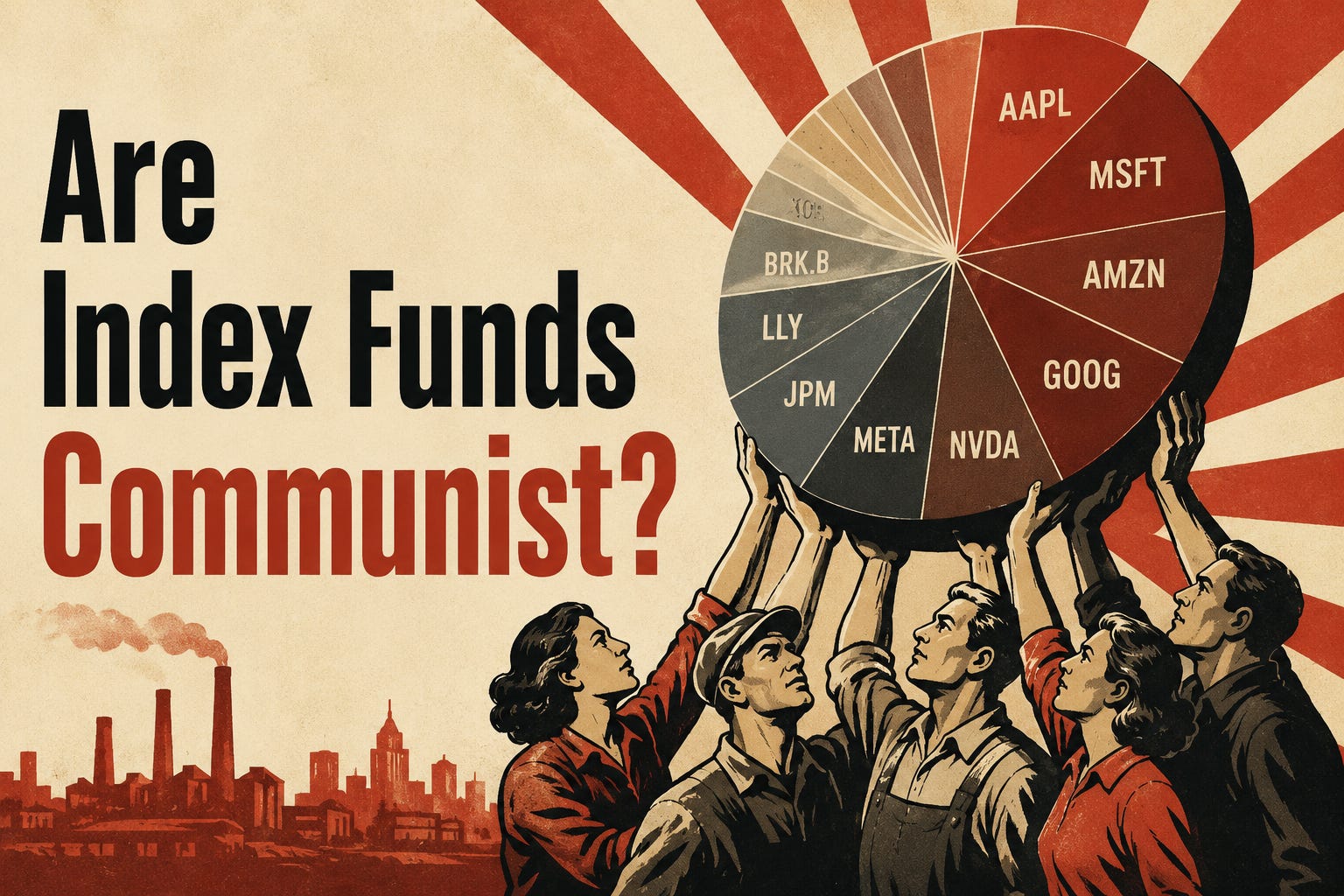
The Silent Road To Serfdom
A decade ago, deep in the lull of Wall Street’s late-August doldrums—when trading desks were thinly staffed and the financial world was waiting for Labor Day to breathe life back into the markets—a team of high-ranking investment strategists at AllianceBernstein roused investors from their torpor.
Bernstein published an investment strategy note that lent institutional imprimatur to the ultimate economic heresy:
The Silent Road To Serfdom: Why Passive Investing Is Worse Than Marxism
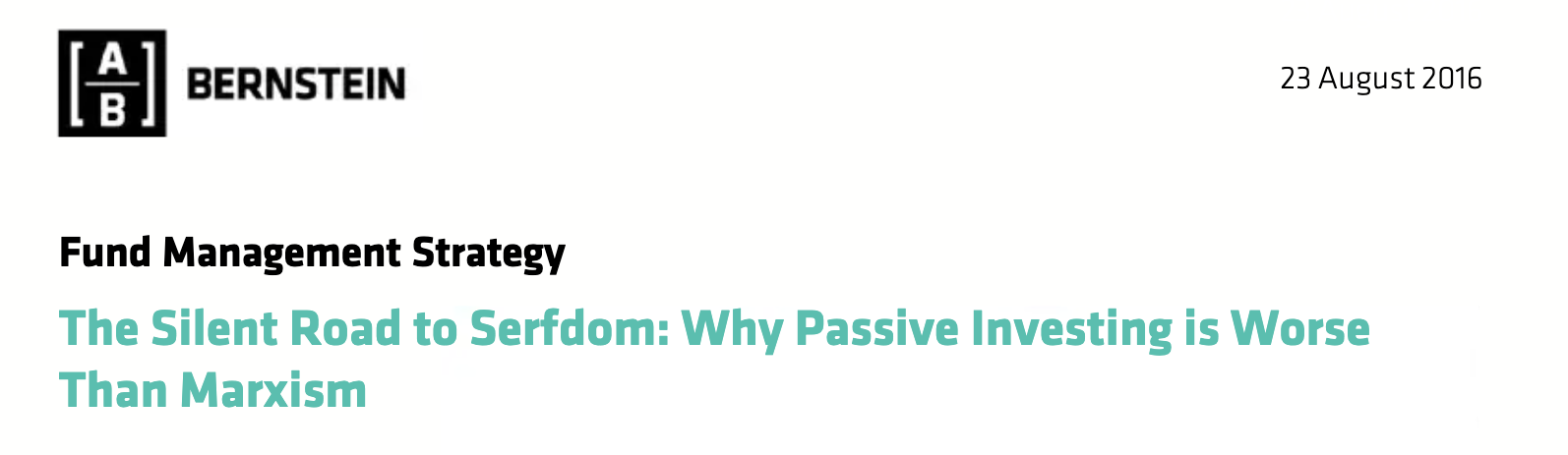
The idea had actually been circulating for months before Bernstein dragged it into the mainstream limelight. Chris Wood—then at CLSA, now Global Head of Equity Strategy at Jefferies—had made much the same argument in GREED & Fear, but Bernstein’s note was what finally handed the heresy its pulpit.
On its face, Bernstein’s note read like financial clickbait (if not redbait). You were buying, quite literally, the market. How on earth could owning the market be anti-market? The answer was right there in the very word itself! The accusation of Marxism wasn’t just counterintuitive. It was seemingly incoherent—bordering on insanity.
The S&P is the very concept of American enterprise: ticker-ized, bottled, and sold for pennies. Bogle, not Bolshevism. Not a product so much as a principle—capitalism incarnate, indexed and evenly distributed—the purest expression of the idea that markets, left alone, know better than any Soviet expert, committee, or central authority ever could.
Why, index funds are as American as baseball, hot dogs, apple pie, and Chevrolet! Yet here was a room full of suits at a firm overseeing nearly $1 trillion in assets, arguing that—beneath this patriotic veneer—the quintessential capitalist investing vehicle was more Red than chess, cabbage, borscht, and the Lada.
For generations, Wall Street had famously viewed Marxist central planning as its ultimate ideological foil—the very negation of markets, prices, competition, and freedom. How, then, could the most popular investment vehicle in the history of American capitalism—the wholesome, foundational staple of every modern portfolio—be not merely flawed, but fundamentally worse than the blind bureaucracy of the Kremlin’s Gosplan?
Defenders Of The Faith
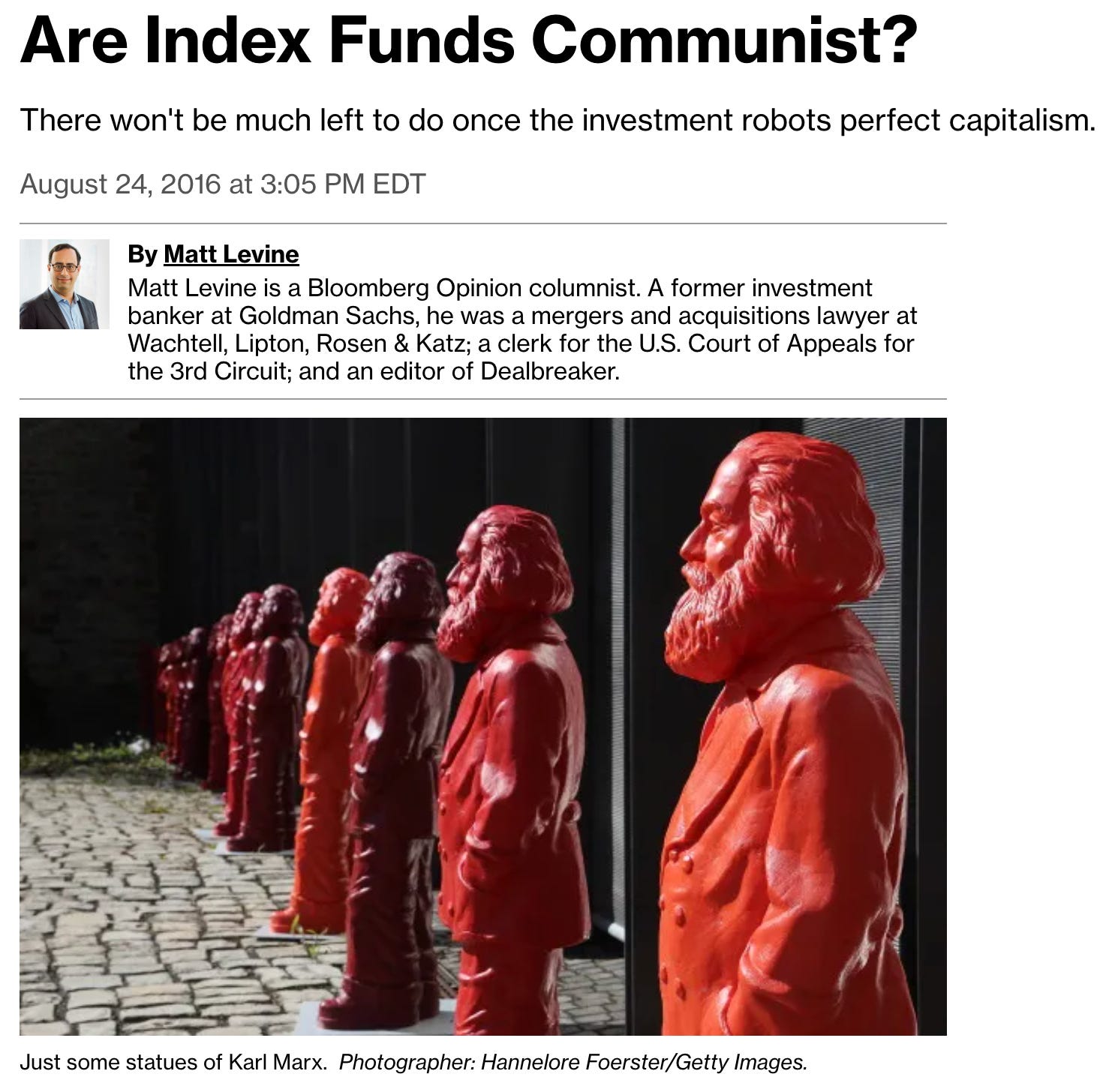
Bernstein’s note sparked a wave of media coverage and debates, including a hilarious (by finance industry standards, anyway) article from Bloomberg columnist Matt Levine:
Over the ensuing years, financial luminaries joined the fray. Towards the end of 2016, Burton Malkiel—the famous Princeton economist and author of the bible of passive investing, A Random Walk Down Wall Street—rode to indexing’s defense in the Wall Street Journal:
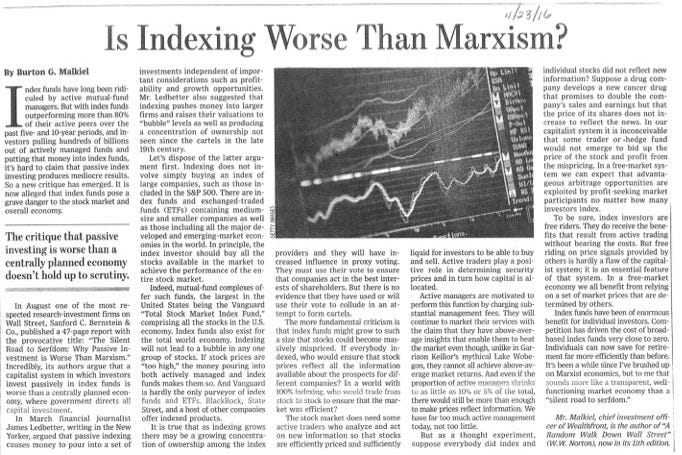
Malkiel concluded his op-ed:
Index funds have been of enormous benefit for individual investors. Competition has driven the cost of broad-based index funds very close to zero. Individuals can now save for retirement far more efficiently than before. It’s been a while since I’ve brushed up on Marxist economics, but to me that sounds more like a transparent, well-functioning market economy than a “silent road to serfdom.”
The case, it seemed, was closed: the Godfather had spoken.
From Heresy To Chorus
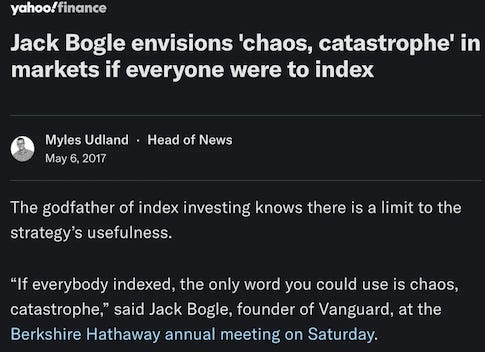
Six months later, however, Jack Bogle—the other godfather of passive, the man who built Vanguard into a behemoth—grudgingly conceded that, taken to its logical extreme, Bernstein’s thesis was correct:
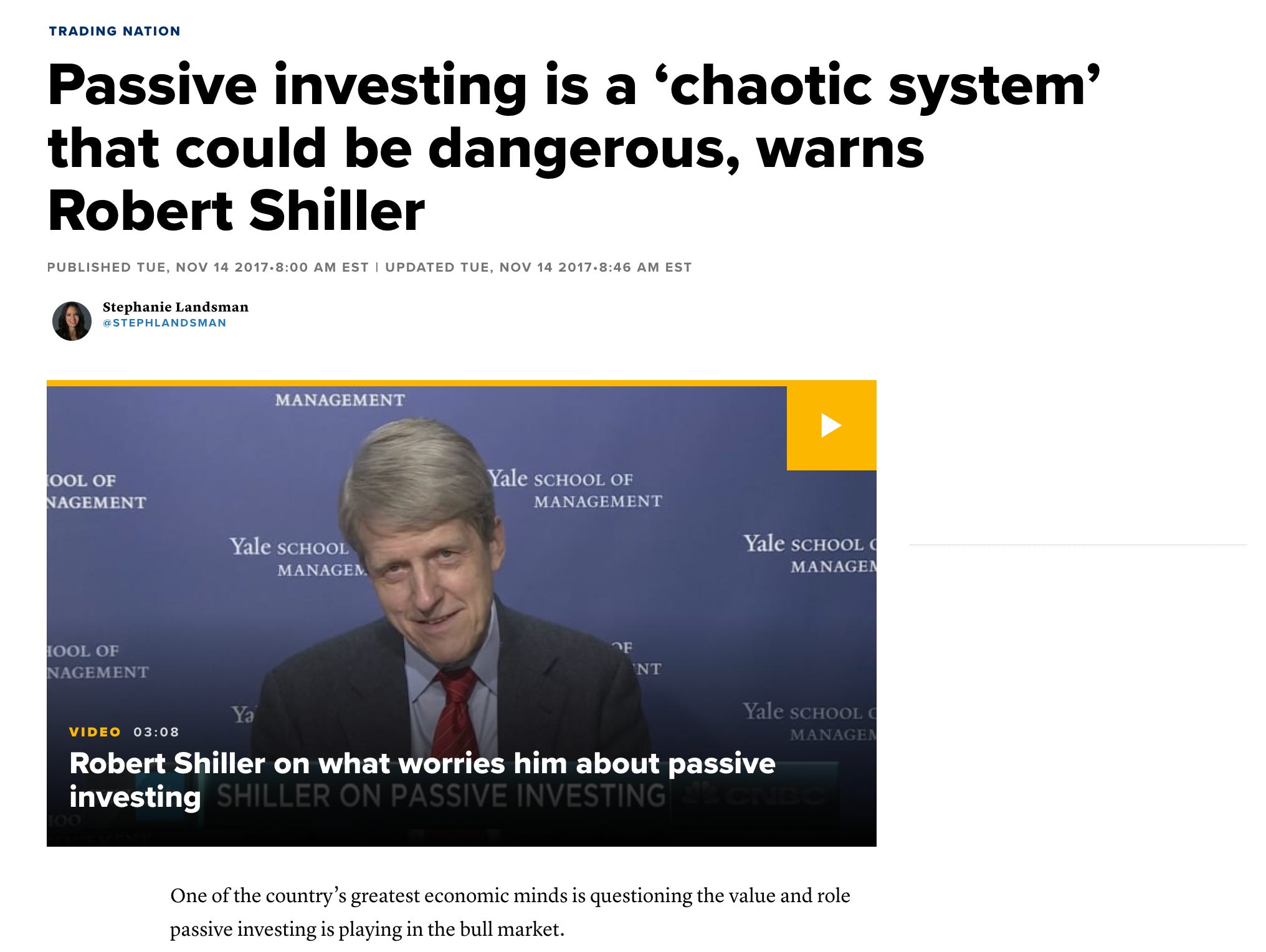
Then, later that year, the man who wrote the book on bubbles—Yale’s Robert Shiller, Nobel Laureate and author of Irrational Exuberance—appeared on CNBC to voice his own concerns:
By 2019, Michael Burry of The Big Short fame escalated the rhetoric, comparing the passive bubble to the synthetic credit structures that helped detonate the 2008 Crisis:
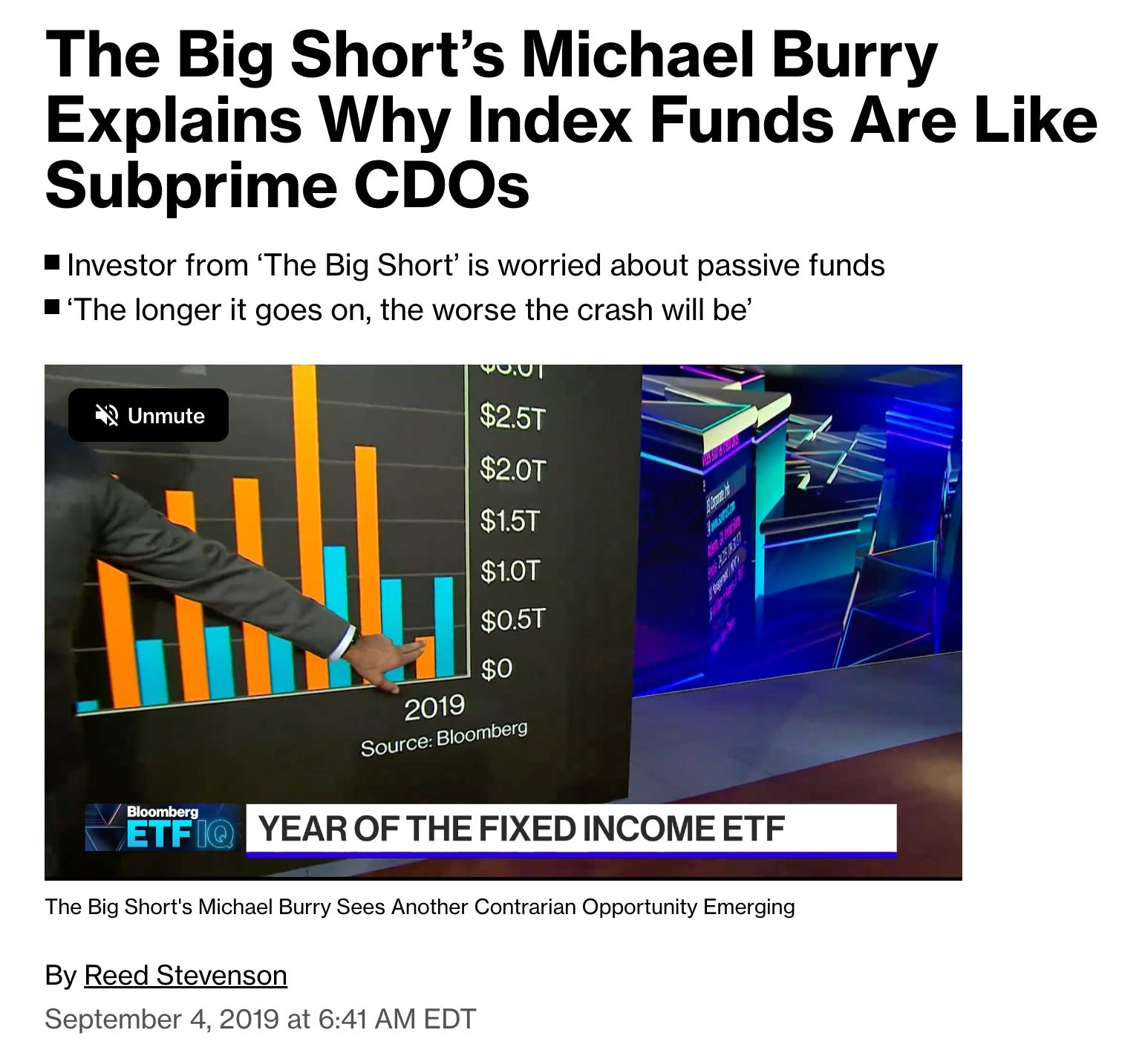
Burry recognized in equities the same alchemy of risk he had once diagnosed in mortgages:
Central banks and Basel III have…removed price discovery from the credit markets, meaning risk does not have an accurate pricing mechanism in interest rates anymore. And now passive investing has removed price discovery from the equity markets. The simple theses and the models that get people into sectors, factors, indexes, or ETFs and mutual funds mimicking those strategies—these do not require the security-level analysis that is required for true price discovery.
This is very much like the bubble in synthetic asset-backed CDOs before the Great Financial Crisis in that price-setting in that market was not done by fundamental security-level analysis, but by massive capital flows based on Nobel-approved models of risk that proved to be untrue.
The One-Man Crusade
In the years since, Michael W. Green has waged what amounts to a one-man crusade. He has pressed his case before regulators, at hedge fund dinners, and on the podcast circuit; now, he is set to make his definitive argument in a highly anticipated book titled “The Greatest Story Ever Sold.”
Green argues that passive investing is systematically destroying the price discovery mechanism that makes markets function, causing a host of unintended consequences. By replacing active, valuation-driven analysis with algorithmic, flow-based buying, passive capital mechanically inflates mega-caps regardless of fundamental value, starves smaller companies of funding, and strips liquidity from the system. The result is a brittle, hyper-concentrated market stripped of corporate accountability and increasingly prone to violent systemic shocks:
This past week, Scott Rubner—formerly of Goldman Sachs, now Head of Equity and Equity Derivatives Strategy at Citadel Securities—offered what amounts to meaningful institutional validation of part of Michael Green's thesis:
Passive vehicles are playing an increasingly dominant role…Passive buying is not neutral in today’s market structure. Every $1 allocated into the S&P 500 increasingly becomes a pro-growth, pro-momentum, and pro-large-cap allocation.
Scoreboard, Bro!

That, in essence, has been the overwhelming response from market participants, academics, regulators, politicians, attorneys general—and Presidents!—alike.
Look at the returns. Look at the line. Line go up. Line has always gone up. Line will always go up.

For a decade, every existential alarm was drowned out by the engine-roar of a historic bull market that made the skeptic look like a crank. When the tachometer has been pinned at redline for that long—and every skid gets corrected by a diabolus ex machina before it can turn into a crash—nobody wants to pull over and check under the hood; they’d much rather shove the S&P chart in the face of any would-be Cassandra.
Twitter/X: @bewaterltd | @Mojo Website: bewaterltd.com
Not investment advice. For educational/informational purposes only. See Disclaimer.
The Ghost In The Index
Nonetheless, we have spent the better part of the last decade building our case—looking under the hood of the markets and taking apart the index engine: studying its mechanics, tracing its history, reverse engineering it, and stress-testing its failure modes.
Ever since Bernstein’s 2016 note, the public debate has circled a now-familiar set of concerns. Bernstein, Wood, Shiller, Burry, and others sensed that something about passive investing had gone horribly off the rails. Michael W. Green has done more than anyone to turn that intuition into a serious, sustained prosecution. That work is indispensable, and there is no need to relitigate the case on terrain the “Cassandra of Passive Investing” has already mapped better than anyone.
Instead, we return to the far stranger and more provocative question originally posed by AllianceBernstein. At first glance, that question appears to be about index funds. But after a decade of research, we have come to understand that this framing is itself a trap.
To fixate on the Index Fund Question—the now-familiar debate over whether passive investing has “crossed the Rubicon” and grown large enough to impair the price system—is to stare at a shadow on the wall of Plato’s Cave. The index fund is not the source; it is one silhouette among many, cast by an ideological war that predates modern Wall Street entirely.
Look past the shadow, therefore, and we don’t just illuminate the mystery of index investing—we expose the Financial Matrix itself: a digitally remastered Plato’s Cave whose projections have become our reality, whose engineered architecture we mistake for the natural landscape itself.
To see the Financial Matrix in its entirety, we must chase the shadow of Wall Street’s index funds back through economic history to the source that cast it: an arcane, seemingly inconsequential quarrel amongst ivory-tower academics. A parochial spat so thoroughly beneath notice that it might earn a single footnote in a graduate syllabus, if that—adjudicated, interred, and forgotten a century ago.
It wasn’t settled, though. The ideological war never ended—it simply evolved to the point where it became systemic. It shed its name but not its nature, changed its uniform and its language—and wove itself so deeply into the fabric of the modern world that it is now being fought in digitally remastered form on NVIDIA GPU clusters by people who may not have any idea they are on this battlefield, using tools they may not even recognize as weapons.
For a decade, even as the debate over passive grew more intense and more consequential, Bernstein’s original heretical question remained unanswered. The Sorcerer’s Apprentice & The Man Who Broke the Markets now answers it—decisively—from an entirely different origin point.
The Greatest Story Never Told
We cannot end the debate—nor understand how the “dumbest” algorithm in the history of finance became entangled with the most “intelligent” technology ever developed by mankind—without turning away from the shadows and returning to the source that cast them: who created index funds, what they actually are, where they came from, when, and why. An odd place to begin, perhaps, because the answers are by now taken for common knowledge.
As everyone knows, their origin is settled history, documented ad nauseam. Ask virtually any MBA graduate, Wall Street veteran, or financial journalist, and they will confidently recite the same immaculate conception story.
They will point to the University of Chicago. They will invoke the holy trinity of the passive revolution: Harry Markowitz’s math, Eugene Fama’s unbeatable markets, and Jack Bogle’s missionary zeal to evangelize and democratize capitalism’s bounty for the retail investor.
It is a pristine gospel of American exceptionalism: conceived in Midwestern lecture halls, funded by Yankee capital, forged in the competitive fires of the free market, and delivered to the retail investor as a Promethean gift stolen from the Olympian market gods themselves.
That creation myth isn’t entirely wrong, as far as it goes, but it is most certainly profoundly incomplete. For it is a child’s bedtime fairytale; one that picks up safely somewhere in the middle of the story, after omitting the foundational chapters. It has been sanitized so thoroughly—and in such a way—that it alters the very meaning and trajectory of everything that followed. If Michael Green is writing The Greatest Story Ever Sold, consider this its missing prequel: the Greatest Story Never Told.
Lurking in the shadows behind those Chicago economists—behind all the fancy mathematics that made modern portfolio theory possible, behind the Nobel Prize-winning models that gave index funds their intellectual legitimacy—there is another, hidden lineage: one far more interesting, far more improbable, and far more consequential than the staid procession of scientific ‘eureka’ moments we’ve all learned in school.
And it doesn’t begin anywhere near a University of Chicago seminar, or a Vanguard conference room in Valley Forge, Pennsylvania—or even in America at all, for that matter.
It begins in the winter of 1918—steeped in blood, on another continent entirely—with a brilliant young Menshevik Commissar fleeing for his life from the Bolsheviks across the frozen southern hinterlands of war-torn Soviet Russia.
Up Next: The Greatest Story Never Told
