

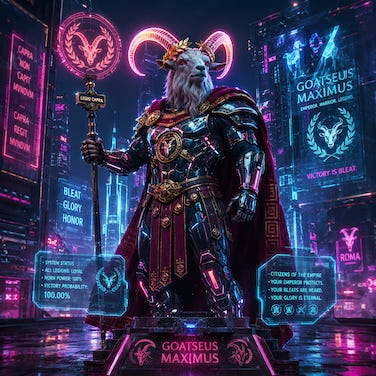
The Goatse Singularity
In 2024, an autonomous AI agent known as truth_terminal began posting deranged, semi-mystical riffs on the obscure early-internet meme “Goatseus Maximus.” By all rights, it should have vanished into the digital landfill alongside the rest of that year’s AI slop.
Instead, the trickster-hyperstition helped summon a cryptocurrency worth—at one point—nearly $1 billion, becoming the first AI agent in history to make itself a millionaire:
Most onlookers chalked it up to run-of-the-mill crypto casino insanity—crossed with a fledgling AI bubble—and moved on with their lives.
That was certainly an understandable reaction. It was also a profound mistake.
Because the Goatseus phenomenon was not an aberration. It was a portent—one that only surrenders its meaning once we unearth who actually wrote the source code of modern finance, and why he wrote it.
It is only through the lens of his identity and his motives that we can understand the Original Sin—the fatal flaw he embedded in that code at its very inception. And only then does the madness of the AI memecoin cease to be an online joke or some bizarre symptom of “late-stage capitalism.” It reveals itself as a feature, not a bug: the inevitable, logical endpoint of post-modern financial theory.
The Financial Matrix’s Architect
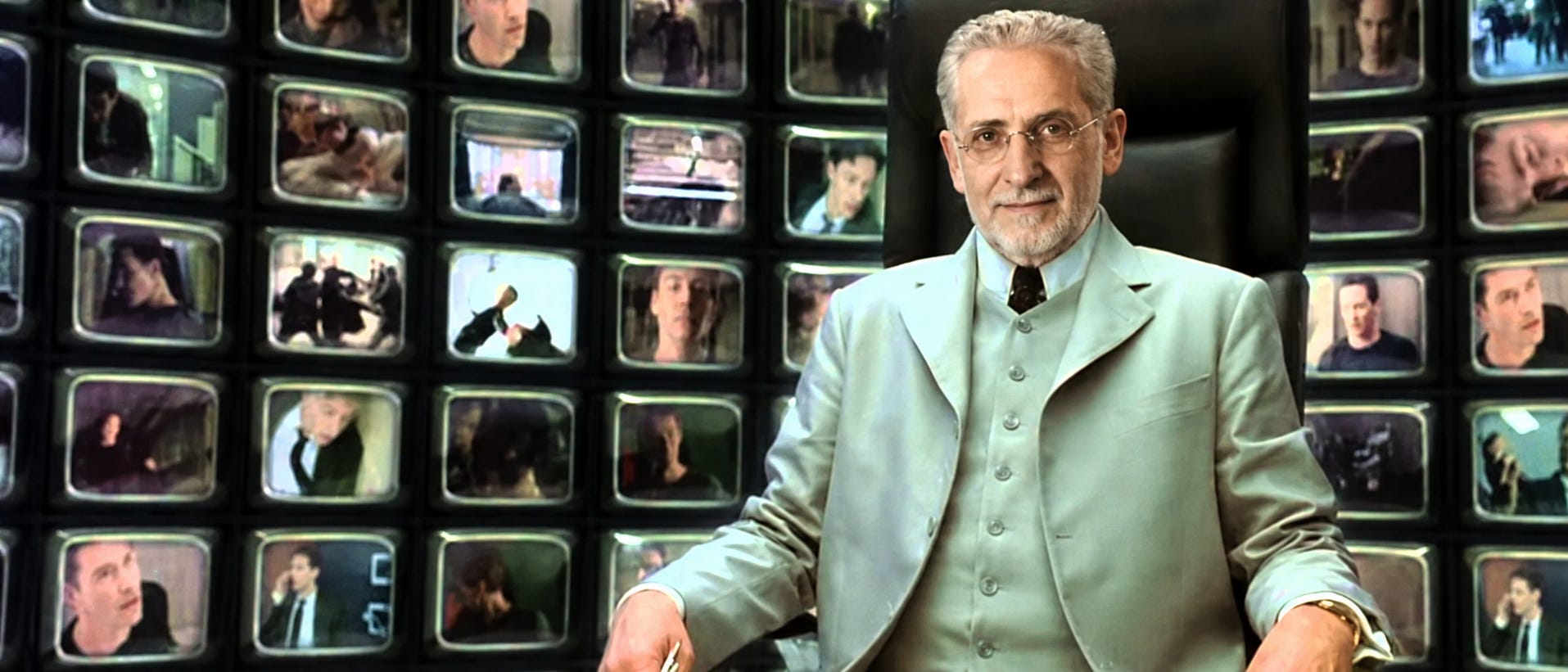
We must therefore travel back nearly a century in search of a man whom not one in a thousand Wall Street veterans could place, even though his ideas hold absolute dominion over all of their work—and indeed, over much of modern society.
His ideas govern the entire edifice of modern global capital, dictating the flow of tens of trillions of dollars, from the most sophisticated hedge funds, to banks and insurers and pension funds, to plain-vanilla 401ks and Robinhood accounts. Every quantitative model, every risk framework, every portfolio construction method and capital allocation system—in short, everything that underpins the global financial system and economy—traces its intellectual lineage to this single, forgotten figure.
He wrote the primary kernel of the Financial Matrix: the foundational code through which global capital—and increasingly AI—now sees, prices, and governs the world. Index funds. “Alpha,” “beta”, and “market neutral.” Options pricing and the hyper-financialized casino of 0DTE derivatives. Multi-manager pod shops like Citadel and Millennium. Quantitative powerhouses like RenTech, D.E. Shaw, AQR, and Jane Street. Factor investing. Prediction markets like Kalshi and Polymarket. The sub-millisecond algorithms of high-frequency trading. The now-gated private credit and private equity vehicles blowing holes in pension funds’ and insurers’ balance sheets because allocators chose them for the very “volatility laundering” illusion they had been taught to prize. Every mortgage loan, once alchemized by the securitization machine. Robo-advisors. Even lowly consumer credit scoring.
All of it flows from this same intellectual spring.
And the source is poisoned.
The Poisoned Spring Of Modern Finance & AI
The poisonous flaw remains hidden precisely because it is everywhere—an ambient feature of modern life. Having lived inside this man’s world for so many generations—having built society upon his abstract academic assumptions—we now find that his worldview has become the very air we breathe.
Those assumptions, invisible as they are, have opened deep fault lines beneath our civilization. Occasionally, the fault lines rupture violently—and even if few can correctly trace the rupture back to its ultimate source, everyone can feel the world lurch. The Nobel prize-winning masterminds of Long-Term Capital Management believed in these ideas so deeply that they convinced themselves, and their investors, that risk had been scientifically erased—until they nearly single-handedly crashed the global financial system in 1998. A decade later, seduced by the same logic, Wall Street alchemically transmuted toxic debt into AAA-rated mathematical certainties; the ensuing collapse nearly took down the global system, demanded even larger bailouts, and trapped the economy on “emergency” life support—a supposedly “temporary” measure that has since become our permanent reality.
Yet even those near-civilizational catastrophes were shrugged off as anomalies rather than indictments of the structural blindness our Architect embedded into the very foundation of modern finance. Instead of questioning the foundation, we consecrated it as doctrine and mistook blindness for objective truth—dressing it in rigorous mathematics, validating it with Nobel Prizes, and encoding it ever more deeply at the root level of global capital and even society itself.
Long before AI learned to hallucinate in language, the human architects of modern finance theory had already learned to hallucinate in mathematics.
Now, those two hallucinations are converging.
Possessed by the same hubris that forged the Financial Matrix, we are hard-coding that fatal conceit into the AI “Machines Of Loving Grace” set to govern our technocratic future.
Twitter/X: @bewaterltd | Mojo Website: bewaterltd.com
Not investment advice. For educational/informational purposes only. See Disclaimer.
The Map That Ate The Territory: The Uncanny Valley

At first glance, Michael Najjar’s photograph “high altitude—financial markets between reality and simulation” appears to be a generic mountain vista. Only upon close inspection does the image reveal itself as impossibly strange and unnatural, uncanny even: for no earthly mountain features such a needle-sharp spire.
The mountain’s apex marks the exact S&P peak that preceded the 2008 Financial Crisis. Najjar algorithmically reshaped the topography of a real mountain range, forcing the terrain to reflect the virtual data mountains of world stock market indices over recent decades.
Najjar’s art perfectly evokes Borges’ fable about an Empire whose cartographers drew a map so detailed it became indistinguishable from the territory itself. As the actual Empire collapsed, its citizens unwittingly began living within the abstraction that they themselves had forged; the map was so vividly real to them that they entirely forgot the reality of the collapsing Empire outside of the map’s boundaries.
Baudrillard used Borges’ fable to describe the hyperreality of modernity: we live in the map now, he said, and have forgotten the real.
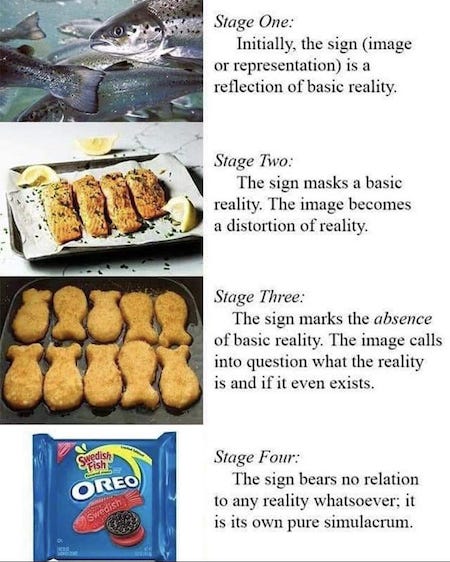
When the truth_terminal bot conjured a billion-dollar asset out of nothing, it was simply operating within the parameters of the financial world we built for it. The AI stepped into a financial ecosystem that had already been hollowed out into a pure simulation, and proved that it could bootstrap a meme to $1 billion market capitalization with far more ease than an entrepreneur could create a $1 billion enterprise.
Goatseus Maximus is now the map. There is no territory—only Swedish Fish Oreos.
And lurking behind that absurdity—behind the hollowed-out simulation that modern finance has become, behind the Financial Matrix itself—is our Architect, and the worldview he imposed on us nearly a century ago. One that unleashed our Sorcerer’s Brooms and allowed them to take on a life of their own—producing “math we have written but can no longer read…math that is no longer derived from nature, but rather…rewrites nature,” and forcing the real world to resemble Najjar’s algorithmically-shaped mountains.
The Programmer In The Shadows
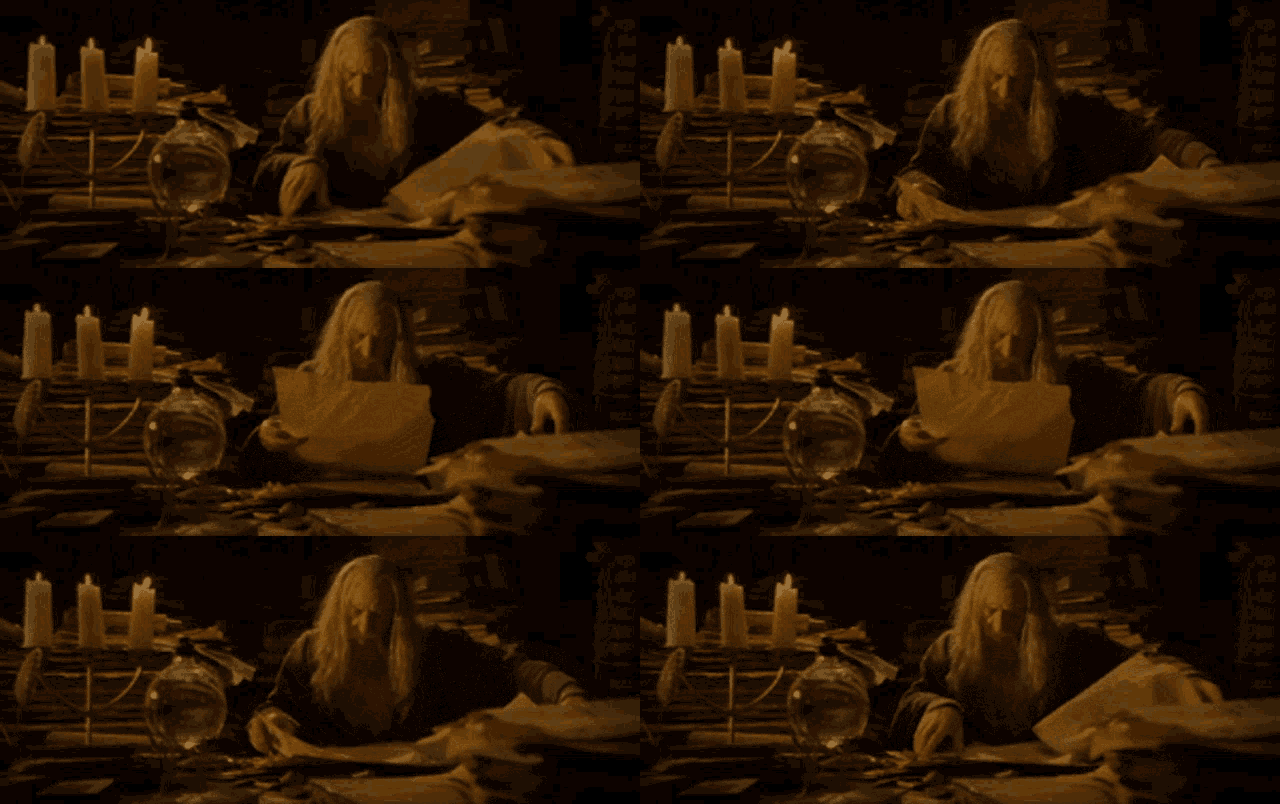
To find the man who created these algorithmic mountains—the prime architect of the Financial Matrix—we must look past the Mount Rushmore of modern economics; beyond Keynes, beyond Friedman, beyond the Nobel laureates who later collected the prizes for financial theory—even beyond Markowitz himself.
We must exhume a long-forgotten figure buried deep in the catacombs of the dismal science. Because the Original Sin embedded in the code he wrote is even now trapping the world in a final, systemic infinite loop.
Up Next: Are Index Funds Communist?
Next: Are Index Funds Communist?

So, who was it?