


In Part I: Ben Graham Was Wrong, we argued that value investing’s failures in recent decades are structural rather than merely a streak of bad luck. To understand this failure, we must first return to the source of the Cargo Cult—to Benjamin Graham himself. And to understand Graham, we must understand that his strategy and tactics were first and foremost a product of his time.
The textbook list of differences between Graham’s era and our own is well-worn: richer opportunity set, greater market inefficiencies and informational advantages, fewer competitors, the absence of computers and passive ETFs. But perhaps the most consequential difference has gone largely unremarked upon:
Graham invested under an entirely different monetary operating system that no longer exists anywhere in the world.
This is perhaps implicitly obvious to the point of being self-evident once stated, however the implications of this fact have received surprisingly little treatment in the value investing literature.
Ironically, one man who would have understood the implications clearly is Graham himself. After all—unknown to virtually all of his modern disciples—Graham spent years architecting an entirely new monetary system. He published his plan in an obscure treatise he considered to be his most important contribution to posterity, dwarfing even Security Analysis. As Columbia economist Perry Mehrling observed, for Graham “the disconnect between the world of money and the world of goods was fundamentally a source of macroeconomic investment risk that could upset any amount of careful security selection by the conservative value investor.”
Graham’s active investing career was bookended by major shifts in the global monetary system, but throughout it all, one thing remained constant: money was always loosely tied to a tangible anchor. Graham’s “value” framework is inseparable from the monetary environment in which he operated—one so alien to our own that modern investors struggle to even conceptualize it.
The modern value investor’s reliance on Graham’s ideas fails because Graham’s framework is not a universal principle of investing. Value investing is a brilliant tactical adaptation to a monetary reality that no longer exists, applied in recent decades with hardly anyone stopping to ask whether the underlying conditions required for its success still hold in the age of the Financial Matrix and Silicon Sorcery.
But this indictment reaches further than Graham’s explicit disciples and those investors who still read Graham literally. Graham’s assumptions are load-bearing for “value” discussions broadly. They echo even through Buffett, through GARP, through DCF users, through “compounder bros” and beyond—wherever “value” remains the operative word. Evolving beyond Graham’s tactics is not liberation from his assumptions.
Before we can know which parts of the value tradition are worth preserving, we must first understand which ideas still hold and which are artifacts of a vanished monetary world. Only then can we begin to sketch what a rebuilt framework might look like.
Twitter/X: @bewaterltd | Mojo Website: bewaterltd.com
Not investment advice. For educational/informational purposes only. See Disclaimer.
1914: The “End Of Sweet Reasonableness”
Graham’s defensive, price-conscious methodology was tactically sound for his era: the business cycle was much more volatile and frequent than it is today, featuring panics and brutal periods of severe deflation punctuated by occasional periods of inflation. As a result, cash—at the time a claim on gold—was king.
As Jim Grant noted, Graham himself recognized when the investing world began to change:
For Graham, an era of sweet reasonableness in investment thinking seemed to end around 1914. Before that time, the typical investor was a businessman who analyzed a stock or a bond much as he might a claim on a private business.
1914. One year after the Federal Reserve’s creation. Before the Fed, investors demanded safety and high asset backing because there was not yet a “Lender of Last Resort” subsidizing public equities and incentivizing risk-taking.
The Fed, however, was explicitly created to provide “elasticity” to the money supply, allegedly to prevent—and short-circuit—these panics by providing “liquidity”. From 1914 on, the newly formed central bank broke the discipline of the gold standard and orchestrated a massive, inflationary credit expansion to finance World War I:
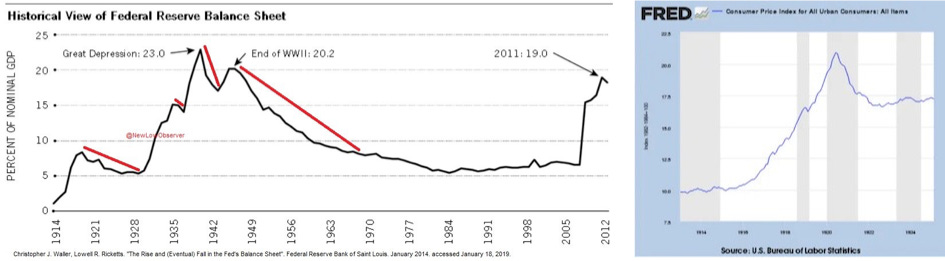
Graham watched on in horror as the “sweet reasonableness” of analyzing stocks as if they were private businesses evaporated, replaced by a casino in which liquidity dominated returns: the credit inflation fueled a speculative boom that culminated in the severe Forgotten Depression of 1920–1921. (One can only imagine what he would think about Mr. Market’s Schizophrenic Break of the COVID era).
The Fed again flooded the market with liquidity, creating another credit bubble—the Roaring Twenties, whose parallels to modern Bitcoin Treasuries we explored here—which itself culminated in the Crash of ‘29 and the Great Depression. By the early 1930s, the market had dropped significantly. Graham, analyzing valuations, believed stocks to be absurdly cheap. Thinking the worst was over, he bought heavily and employed margin. Because he was leveraged, the agonizing, grinding bear market of 1931-1932 devastated his fund; the Benjamin Graham Joint Account lost roughly 70% of its value between 1929 and 1932.
Graham lost his own wealth, was forced to give up his apartment, and survived largely on his teaching salary at Columbia University as well as his wife’s income. He refused to close the fund, however, and worked for zero compensation for several years until he earned his investors’ initial capital back.
Groceries, Not Perfume
But the origins of Graham’s value framework—and the traumas that produced them—predate even the stock market crises he endured. In “The Curious Truth of How Graham Created Value Investing”, his granddaughter’s research reveals that Graham arrived at what we now call value investing not through ivory tower theorizing or even his practical experience on Wall Street, but rather through hunger. After his father died, Graham’s family was left destitute. His mother—indifferent to domestic labor—assigned the grocery shopping to her youngest son. Ben learned early what it meant to stretch quarters across a family of four.
Graham’s granddaughter found additional evidence of the origins of his framework in his memoirs and hiding in plain sight on the back cover of the 1973 fourth edition of The Intelligent Investor:
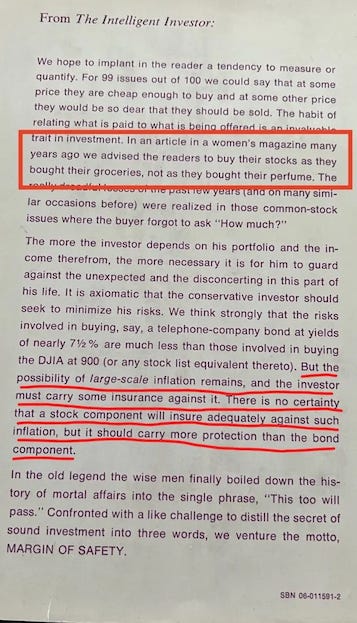
(Note, too: on that same back cover, writing amidst the 1970s inflation, even Graham acknowledged that “the possibility of large-scale inflation remains, and the investor must carry some insurance against it”—conceding that his framework had no reliable answer to inflation, only the vague hope that equities might outperform bonds. It is precisely this unresolved gap that our Multiflation Method is designed to address.)
The psychological bedrock of Graham’s value system—and the ultimate category error underlying most value-oriented methodologies generally—rests on a single, defining analogy: buy stocks the way you buy groceries, not perfume. Graham observed that the masses bought stocks like luxury goods—chasing brand names and paying up for popularity and “vibes”—and concluded that investors must instead become more savvy grocery shoppers:
From Stone-Broke Son to “Father of Value Investing”
Benjamin Graham…shows us that our youthful difficulties—in his case, living on the edge of poverty and complying with his mother’s demands that he do typically female chores—can incite creativity. His boyhood burden taught Ben a skill that became the crux of his acclaimed achievement. The son who shopped for bargains metamorphosed into the father of value investing…
Ben, the small boy with scant cash in his pocket, never bought anything—neither liver nor onions, apples nor oranges, used tennis balls nor baseballs—without first calling out in his bright, clear voice: “How much?” His sharp mind quickly analyzed: Is this item priced low enough to be worth buying?
The Traumatic Legacy of Graham’s Childhood & Wipeout
Graham had a lot to learn as an investor because his investment principles were developed during the Great Depression, and he designed his investment strategy around making sure he never had to lose money again. It left him with an aftermath of fear for the rest of his life, and all his methods were designed to keep that at bay.
—Charlie Munger
In the modern self-help and education industries there is much talk of Fixed Mindset and Growth Mindset. The father of value investing was—very rationally, given his experiences—the fixed mindset in investing made flesh, borne of the traumatic psychological scars he accumulated throughout his childhood poverty and near-wipeout during the Depression.
Graham’s experience continually hammered the same lesson over and over: the only variable investors can control is the price they pay; the goal is to buy assets so cheaply that even if the world falls apart, investors won’t lose their principal.
What emerged from Graham’s traumas was effectively a doomsday bunker against deflation—perfectly engineered for a world of hard(er) money, frequent panics, and occasional spikes in inflation that were soon remedied by deflationary collapses. Graham himself was so brilliant and his philosophy so elegant that few value investors thought to revisit the framework from first principles after the “Nixon Shock” of 1971—or even after the 2008 Financial Crisis and the advent of the Financial Matrix.
During Graham’s time—under a less overtly inflationary system at least partly tied to gold—cash itself acted not only as safe harbor but as productive asset: its purchasing power was periodically reinforced by deflation, while retaining valuable optionality. One of the primary macroeconomic risks of the era was deflationary collapse, as seen in episodes such as the Panic Of 1907 (which wiped out Graham’s mother’s life savings), the contraction of 1920-1921, the Crash of 1929, and the Great Depression. As a result, companies could often be purchased for less than their liquidation value.
However, it is a mistake to treat the assumptions underpinning a Depression-era survival tactic as a universally true law of investing. See it for what it is: a brilliant, localized adaptation to the monetary operating system of his day. Optimizing for margin of safety and hoarding cash to wait for discounted “onions” was a brilliant, low-risk strategy for that era; over-extending oneself on the risk curve and trying to pick long-term winners seemed pointless at the time given the attractive returns one could generate in “cheap” stocks. Furthermore, as Graham perhaps alluded to in the back cover of the 1973 edition of the Intelligent Investor—at the time he didn’t have to worry about central banks printing a never-ending supply of money to prop up markets or devalue the cash on a company’s balance sheet.
Stocks Are Not Chopped Liver
In applying the value-conscious grocery shopping framework of his youth to the foundation of sound investing practice, Graham made a category error that tends to haunt even his evolved disciples today.
When young Ben found discounted onions, or substituted cheaper shallots for onions, he was optimizing within a fixed budget for commodity goods sharing nearly identical utility—not dissimilar conceptually to the arbitrage situations that Graham would so successfully pursue later in his career.
An onion is an onion. A shallot is a close substitute to an onion. Both make for a perfectly edible meal. When Graham bought cheap groceries, he took physical delivery of the commodity and his family consumed it immediately—the value was immediately realized. Penny-pinching and substituting cheap onions for expensive shallots is a direct, risk-free optimization within a zero-sum game in which the only way to “win” is to extract value at the point of sale—by paying the absolute lowest price possible for the commodity.
But equities are categorically unlike commodities and groceries. In The Wealth of Nations, Adam Smith drew a sharp line between productive assets like factories, which create goods that “replace the capital employed” and generate a surplus, and unproductive assets like onions, which “perish in the very instant of its performance.”
By treating stocks as if they are household groceries, many of Graham’s modern disciples are applying the rules of zero-sum non-productive coupon-clipping to save on consumption goods to positive-sum capital allocation. When a stock is treated as merely a cheaper or pricier version of an onion, it confuses a productive asset with a consumption good, collapsing the distinction between the onion to be eaten and the farm that can grow many onions: an ongoing engine of surplus creation that reinvests, compounds, and expands the economic pie over time.
Munger and Buffett recognized this error clearly and rebuilt their approach around it. Rather than hunting for cheap onions, they went looking for exceptional farms at “fair” prices. This was a genuine and important advance over Graham; many value investors, however, never made this leap and continue to gravitate toward “cheap” situations.
But solving the productive-asset problem does not resolve value's other category errors—and those errors apply broadly, including to investors who have absorbed Berkshire's lessons about business quality. Whether they apply to Buffett and Munger themselves is a more complicated question, addressed in their dedicated section later in this series. What can be said here is that Buffett and Munger were true investing savants, and Berkshire's structural position—permanent capital, tax-advantaged insurance float, board representation, reputation, proprietary deal flow and so forth—substantially mitigates or outright solves many issues with value investing. Berkshire's record tells us a great deal about what Buffett and Munger can do operating within those structural advantages, and rather less about the potential for value investing more broadly.
For everyone else—including the many investors who have absorbed Berkshire’s lessons about business quality without inheriting its unique structural advantages—three deeper problems persist, each of which we will cover in dedicated later sections. The first is the problem of enforcement, which we will explore in The Continuum of Force. When Ben bought cheap onions, he didn’t need Mr. Market to later agree with him on value—he simply took delivery and ate them. Value investors—generally speaking—have no such mechanism to enforce value realization.
The second is the problem of intrinsic value. The analogy smuggles in an economic error Graham’s disciples have never fully reckoned with: while an onion has an immediate, tangible consumption value, that is not the same thing as intrinsic value. Graham borrowed the onion’s tangible, intuitive ‘certainty’ and applied it to businesses—but even for onions, value is always subjective, always relative, always contextual. There is no Platonic number representing what a business is worth waiting to be discovered by analysts. We examine this in There Is No Such Thing As Intrinsic Value.
The third is the problem of the measuring stick. The analogy assumes that “cheap” and “dear” are stable, meaningful categories—which they generally were under the gold-backed monetary system of Graham’s day. But as we will explore throughout this series, inflation and Multiflation not only erode that assumption but may—in extremis —invert it entirely. We take this up in Inflation: Value Investing’s Kryptonite.
Conclusion:
Graham’s framework was the right answer to a question the market no longer asks—forged in a monetary environment in which treating stocks like onions was not only intellectually elegant but tactically correct. The tragedy is that—even as they evolved his tactics—his disciples inherited Graham’s assumptions and category errors, never stopping to ask whether the monetary conditions underpinning them had ceased to exist.
Graham’s traumatic experiences hardwired “margin of safety” as a survival reflex against the very types of outcomes that governments and central banks are explicitly trying to prevent in the post-2008 environment; even now, the timing of military strikes is apparently calibrated around off-market hours—capital market stability having become, in effect, a national security risk and key constraint on sovereign decision-making itself. And yet Graham’s framework, as we will argue, may prove no more reliable in the very deflationary collapse for which value investors have been patiently waiting (the same type of collapse, ironically, that nearly destroyed Graham himself) than in the inflationary regime that has so hampered them over the past decade.
Next:
Inflation: Value Investing’s Kryptonite
Series Map
Preface: Ben Graham Was Wrong
Part I: The World Graham Built For—History Through Financial Matrix
See Also: The Sorcerer’s Apprentice
Graham’s Universe No Longer Exists: Value, Money, & Macro
Inflation: Value Investing’s Kryptonite
Value In The Age Of Technocracy & The Financial Matrix
The Price Of Everything & Value Of Nothing—Value, AI, & Passive
Part II: Value’s Cracked Foundation
There Is No Such Thing As Intrinsic Value
The Deeper Problem With DCFs
Graham Thought Like An Arb & An Activist
The Continuum Of Force: The Physics Of Value
Introducing The Continuum Of Force: The Missing Variable
The Physics of Value: Force, Event Paths, and Convergence
What Is A Catalyst? Catalyst v. Continuum Of Force
The Myth Of Time Arbitrage
Continuum Of Force Defines Speculation v. Investment
Duration Doesn’t Make Something An Investment
The Problem With a “Private Equity Approach” To Public Equities
Governance & Dark Arts: & The Continuum Of Force
Event Driven
Private Equity & Private Credit
Short Selling & The Continuum Of Force
Margin Of Safety Is Incomplete
Must Include Monetary System & Continuum Of Force
Many Value Investors Misunderstand Inflation & Prices
Moving The Goal Posts: From Arbs to Compounders
The Shapeshifter Problem
Part III: Practice
Value Investing: Process Failures
Idea Generation, Research, & Value In The Age Of AI
Every Idea Is An Island: The Lonely Stock Problem
Live By The Comp, Die By The Comp
Value Investing: Portfolio Management
Value Investing Portfolio Construction Failures
From Portfolio Construction To Portfolio Cohesion
The Problem With Sitting In Cash As A Perpetual Option
You Can Ignore Multiflation But Multiflation Won’t Ignore You
You Can Ignore Factors But Factors Won’t Ignore You
The Multiflation Method: Cohesion Over Collections
The Value Musical Chairs Lifecycle
How Value Traps Are Born
Value Investing In The Mirror: Human Failures
Part IV: The Intelligent Investor, Reimagined
Value & The Multiflation Method
If You Die In The Financial Matrix, You Die In Real Life
What Value Can Learn from Growth, Momentum, Quant, and Pod Shops
Cash & Fixed Income Alternatives for Multiflation
During An Inflation, Limited Prudent Speculation May Be Intelligent
Great series!