

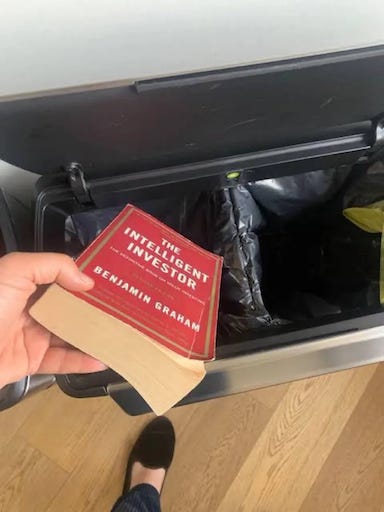
“Tradition is not the worship of ashes, but the preservation of fire.”
Value investing tends to attract some of the most rigorous, disciplined, and intellectually serious minds in finance. For decades, however, those who sleep with Ben Graham’s The Intelligent Investor under their pillows have haplessly watched as their returns have been lapped by somnambulant passive investors, hair-trigger “pod shops,” growth investors who seem to operate on pure instinct, mindless momentum traders, algorithms, casual speculators who don’t read footnotes, and Bitcoin HODLers.
Value investors show up day after day and put in the work, faithfully following their creed—not realizing the voice guiding them is a siren song, luring them onto the rocks.
Twitter/X: @bewaterltd | Mojo Website: bewaterltd.com
Not investment advice. For educational/informational purposes only. See Disclaimer.
To Bury Value Investing, Not To Praise It
The series that follows will prove uncomfortable reading for anyone who has built an identity around being a value investor—not least of all ourselves. This isn’t another “death of value” eulogy, nor is it a pile-on for sport. It emerged from our own reckoning with ideas we once found compelling, frameworks we trusted, and mistakes we made. (Those curious how we as a society arrived here—and why value investing “stopped working”—will find that story in our Sorcerer’s Apprentice.) We don’t pretend to have all the answers—we offer our conclusions here not as verdicts, but as the honest output of a long and sometimes painful process.
We are going to gore the sacred cow that is value investing: the notion that one can buy stocks trading at a discount to intrinsic value—whether old-school “cigar butts” or the more modern evolution focusing on “quality,” “moats,” “compounders” or taking a “Private Equity Approach to Public Markets”—and consistently achieve success through patience, perseverance and sheer intestinal fortitude.
This approach doesn’t work. And it never truly did—at least not in the way most modern disciples imagine it did, nor for the reasons they imagined it working. This isn't to say cheap stocks or value managers never outperform, but rather that the philosophy and strategy are not reliable in the form value investors practice and preach.
Worse, in the age of AI, HyperPrices, and Multiflation, value investing will likely prove even more unforgiving than it already has in recent decades. It is widely presumed by practitioners that—after the excesses of the QE era—value investing is safer now than it had been in the past; the reality is that it is more dangerous because the philosophy as generally practiced today creates hidden asymmetry—in the wrong direction.
But the point here isn’t simply that value investing has become more challenging; it’s what that difficulty exposes about modern financial markets—and perhaps about society itself. Understanding value investing’s theoretical and practical shortcomings reveals something essential about the Financial Matrix itself—and should help every investor avoid making similar errors, regardless of their approach.
Working through these shortcomings forced our thinking to evolve; three concepts crystallized from that process and will recur throughout this series:
Multiflation Method—how to position for a regime characterized by economic whiplash and chronic dislocations
Fundamental Gradient—where are fundamentals heading and are they accelerating?
Continuum of Force—the degree to which you can compel price to converge on what you think it’s worth
Forthcoming Sections
Part I: The Regime That Made Graham
Part II: Value’s Cracked Foundation
Part III: The Flawed Practice Of Value Investing
Part IV: The Intelligent Investor, Reimagined
Modern Value Investing Is A Cargo Cult

We’ve written previously about Cargo Cult Economics. Modern value investing, too, is a primitive religious “cargo cult” as described by Richard Feynman:
In the South Seas there is a Cargo Cult of people. During the war they saw airplanes land with lots of good materials, and they want the same thing to happen now. So they’ve arranged to make things like runways, to put fires along the sides of the runways, to make a wooden hut for a man to sit in, with two wooden pieces on his head like headphones and bars of bamboo sticking out like antennas—he’s the controller—and they wait for the airplanes to land.
They’re doing everything right. The form is perfect. It looks exactly the way it looked before. But it doesn’t work. No airplanes land.
So I call these things Cargo Cult Science, because they follow all the apparent precepts and forms of scientific investigation, but they’re missing something essential, because the planes don’t land.
Like South Seas islanders building grass airports and waiting for metal birds to drop off supplies for them, modern value investing comes complete with its own priests, rituals, and unquestionable doctrines. Investors read Security Analysis like scripture, calculate intrinsic values, quote Buffett’s annual letters, and preach patience and discipline.
They’re doing everything right.
And yet the planes are not landing.
We can already hear the objections forming. “But what about Buffett?” “Didn’t Graham’s methods work for decades?” “When this bubble ends value will have its day in the sun again?” “Haven’t academic studies proven value factors generate alpha?” “What about [insert successful value investor]?”
These are fair questions, and we’ll address them throughout the series.
Untangling The Definition Of Value Investing
Before we proceed further, however, we must acknowledge that “value investing” has devolved into a meaningless umbrella term. Graham’s church has splintered into a dozen competing sects, each with its own metrics, rituals, and explanations for why their version works.
This fragmentation creates a peculiar problem. Contemporary debates about “value investing” often collapse into category errors in which participants unknowingly argue past one another. When critics claim “value is dead,” what exactly are they referring to? Graham’s net-nets and cigar butts? Buffett’s moats? Fama-French factor loadings? Compounders and growth at a reasonable price? By the same token, when defenders retort that “value always works eventually,” which definition are they defending?
Despite their theological differences, however, every denomination operates from the same fundamental assumption. Whether they measure intrinsic value through book value, discounted cash flows, competitive moats, or some other metric, every denomination clings to the same belief: that buying something for less than they think it’s “worth”—with a “margin of safety”—and waiting for Mr. Market to “realize” that worth is an inherently viable investment strategy.
This fundamental assumption, we will argue, is wrong, has proven wrong for decades—and will only prove more wrong from here on out.
This series treats value not as a monolith but as a family of conceptually related approaches; we will critique not just individual value investing approaches, but the entire conceptual framework they share collectively.
Crystallization Into The “Style” Of Value
The very premise underpinning value investing philosophy was never true—or was valid only under very specific conditions that no longer exist. To the extent that value investing was ever ‘correct’ as a philosophy, what passes for value investing today is generally so far removed from its original context that it bears little resemblance to Graham’s approach in any meaningful way. What remains is generally a crude, faded facsimile of Graham’s original insights.
Which makes this dissolution all the more tragic, because we should also be clear from the outset: Ben Graham was an investing genius who has significantly influenced our own investing thinking. The tragedy is that we—and many of Graham’s followers did precisely what Bruce Lee warned against:
Styles tend to only separate man…because they have their own doctrines and then the doctrine became the gospel truth…that you cannot change. But if you do not have styles, if you just say, well here I am…as human being, how can I express myself totally and completely? Now that way you won’t create a style because style is a crystallization [versus] a process of continuing growth.
—Bruce Lee
Like Kung Fu masters, Graham’s disciples took what was once a living, adaptive response to a specific historical environment and crystallized it into eternal doctrine. The Depression-era tactics—net-nets, deep asset coverage, cigar butts—were rational answers to a world of sound money, deflationary risks, and not-infrequent panics and crises. Transplanted into the Financial Matrix—a fiat world of chronic inflation, Fed backstops, the alchemy of risk, financial repression, and passive and algorithms, these tactics are as useful as a map to a city that burned down.
We suspect that Graham himself—were he operating today—would be the first to abandon the cargo cult that now worships at his altar. More provocatively, we’d even go so far as to posit that he would recognize a kindred soul in Paul Singer’s Elliott Management far more readily than in most of his value disciples—his most famous protégé Warren Buffett included.
What’s Coming
Part I: History
We begin with the father of value investing: Ben Graham himself—the world that made him, and the Financial Matrix that has since replaced it. Indeed, what does it even mean to “measure” value in the age of the kaleidoscopic money, Multiflation, AI, and HyperPrices?
Part II: Theory
In Part II, we question value investing’s first principles and establish why the entire enterprise of value investing as currently practiced is misconceived from its foundation.
We will confront the reality that intrinsic value does not exist the way value investors believe it does. From there, we introduce the missing variable: the Continuum of Force—the degree to which an investor can compel an asset to converge on its supposed value.
We will then show that “margin of safety”—absent an accounting for both the monetary system and one’s position on the Continuum of Force—provide only a comforting illusion of safety measured with a rubber ruler.
These are not merely technical problems with value investing to be patched. Graham’s misunderstandings concerning money, the nature of prices and value, and certain other assumptions—while understandable, even brilliant, for his era—underpin the entire value investing edifice and have subsequently been proven incorrect or invalidated. For nearly a century, the errors could be safely ignored. Then came the Global Financial Crisis—and after it, Graham’s errors and omissions have become too costly to ignore.
Layered over all of this is Multiflation: a monetary regime that radically alters the value calculus and leaves value investors structurally trapped—capped on the upside, yet remaining exposed to downside risks on every axis.
Part III: Practice
In Part III, we turn to practice and process failures—particularly those that make value investors uniquely vulnerable to Multiflation.
We will also turn inward—to the behavioral biases and blind spots—and what we value investors can learn from growth investors, pod shops, momentum traders, and quants.
Part IV: Preserving the Fire
But this series is not an exercise in nihilism—nor would we leave you only with ashes. For every flaw we expose, we will rekindle Graham’s fire and offer an alternative approach.
Valuation still matters of course—but it is incomplete without additional dimensions including the Continuum of Force and the direction and rate of change of fundamentals. Not just how cheap is this? but which way are fundamentals moving, and how fast are they accelerating?
That single shift in mentality has helped us avoid more unforced errors than any intrinsic value calculation ever did. The Gradient Framework asks where it’s going. Static “cheapness”, moats, and margin of safety are not inherently safe. Most value metrics are photographs of a car that tell us nothing about whether the car is parked safely or hurtling toward a cliff.
Benjamin Graham wrote The Intelligent Investor, not The Doctrinaire Investor. Faced with a profoundly altered investment landscape, he would not have rigidly clung to a cargo cult—even one of his own making.
Graham would Be Water.
Series Map
What follows is a working outline; some entries have placeholder links to our related work while the individual pieces are being published. We expect to revise it as the argument develops and, frankly, as readers push back, pick fights, and ask questions we haven't thought to answer yet.
Part I: The World Graham Built For—History Through Financial Matrix
See Also: The Sorcerer’s Apprentice
Graham’s Universe No Longer Exists: Value, Money, & Macro
Graham Thought Like An Arb & An Activist
Value In The Age Of Technocracy & The Financial Matrix
Part II: Value’s Cracked Foundation
There Is No Such Thing As Intrinsic Value
The Deeper Problem With DCFs
The Continuum Of Force: The Physics Of Value
Introducing The Continuum Of Force: The Missing Variable
The Physics of Value: Force, Event Paths, and Convergence
What Is A Catalyst? Catalyst v. Continuum Of Force
The Myth Of Time Arbitrage
Continuum Of Force Defines Speculation v. Investment
Duration Doesn’t Make Something An Investment
The Problem With a “Private Equity Approach” To Public Equities
Governance & Dark Arts: & The Continuum Of Force
Event Driven
Private Equity & Private Credit
Short Selling & The Continuum Of Force
Margin Of Safety Is Incomplete
Must Include Monetary System & Continuum Of Force
Many Value Investors Misunderstand Inflation & Prices
Moving The Goal Posts: From Arbs to Compounders
The Shapeshifter Problem
Part III: Practice
Value Investing: Process Failures
Idea Generation, Research, & Value In The Age Of AI
Every Idea Is An Island: The Lonely Stock Problem
Live By The Comp, Die By The Comp
Value Investing: Portfolio Management
Value Investing Portfolio Construction Failures
From Portfolio Construction To Portfolio Cohesion
The Problem With Sitting In Cash As A Perpetual Option
You Can Ignore Multiflation But Multiflation Won’t Ignore You
You Can Ignore Factors But Factors Won’t Ignore You
The Multiflation Method: Cohesion Over Collections
The Value Musical Chairs Lifecycle
How Value Traps Are Born
Value Investing In The Mirror: Human Failures
Part IV: The Intelligent Investor, Reimagined
Value & The Multiflation Method
If You Die In The Financial Matrix, You Die In Real Life
What Value Can Learn from Growth, Momentum, Quant, and Pod Shops
Cash & Fixed Income Alternatives for Multiflation
During An Inflation, Limited Prudent Speculation May Be Intelligent