


Practical men who believe themselves to be quite exempt from any intellectual influence, are usually the slaves of some defunct economist. Madmen in authority…are distilling their frenzy from some academic scribbler of a few years back.
―John Maynard Keynes
Designed, Not Discovered: The Ideology Is The Architecture
In Part I: Hypermarkets, we introduced the Architect: the long-forgotten father of finance, whose influence permeates every aspect of the modern economy and financial system.
In Part II: Are Index Funds Communist? we revisited the decade-long debate over whether index investing has “crossed the Rubicon”—grown large enough to impair the price system.
But even the boldest heretics treat passive investing as a brilliant “free market” innovation rooted in Nobel Prize-winning science that simply grew too large—a victim of its own runaway success.
The market distortions now visible under pervasive passive indexing are not merely the result of scale, however—even if scale is what finally made them impossible to ignore. They are the wages of an Original Sin committed by the Architect at the birth of modern finance itself—one whose true origins and nature have never been properly told.
Of course, a controversial beginning proves nothing on its own, nor do compromised origins in and of themselves invalidate everything downstream. Einstein was famously a socialist, and Wernher von Braun’s rockets reached the moon despite the ideology of his youth.
But finance is neither physics nor rocketry, and there is a world of difference between discovering a law of nature and attempting to write one. In modern finance, what masquerades as organic discovery has, from its very inception, been deliberate legislation—a claim so sweeping, and so improbable on its face, that it can merely be asserted here, accumulating the weight of proof across the chapters to come.
Nevertheless, the Nobel Prize-winning financial models that now govern trillions in assets did not reveal underlying reality—they purposefully remade reality in the image of the Architect’s ideology. As these models hardened into the Financial Matrix, that animating ideology became its organizing law, conscripting economic and social reality into its service.
When Ben Hunt warned that markets had become a ‘political utility,’ his diagnosis was more literally accurate than even he could have known: what he identified is not a recent corruption of the market, however, but rather a feature hardcoded into its architecture at the moment of Original Sin nearly a century ago.
Expose the Architect and his ideology, and we entirely invert the foundational myth of global capitalism, forcing us to recast everything we think we know about the markets, about finance—even about twentieth-century history itself.
The Map Rewrites The Terrain
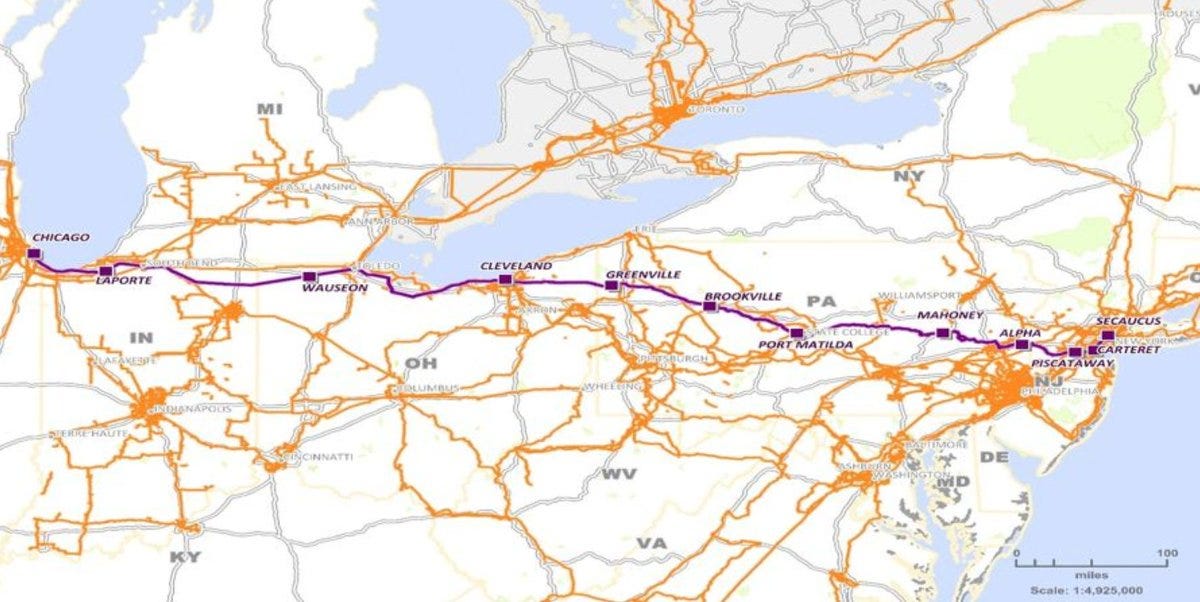
An 825-mile trench runs from New York to Chicago, its path cleared by rock saws and dynamite blasts—the culmination of a secretive $300 million project to forge the straightest route geography would permit between the two financial centers.
It carries no passengers; it moves no water, oil, freight, or electricity.
It carries one kind of traffic, and exists for only one reason: so that an algorithm can execute a trade three milliseconds faster than competing algorithms—“37 times faster than a person can click a mouse.” The fiber optic line, built by Spread Networks and vaulted into notoriety by Michael Lewis’ Flash Boys—his exposé of High Frequency Trading (HFT) and Flash Crashes—became the physical emblem of an economy optimized for financial algorithms.
The trench itself ended at a server farm in New Jersey, but as the network’s signal breached lower Manhattan, the city itself began to contort around the vast infrastructure required to process it. The signal surfaced at 60 Hudson Street—the former Western Union headquarters, now a massive carrier hotel boasting 45,000 square feet of server space—making the traditional servers down on Wall Street agonizingly slow by comparison. A fierce proximity war erupted. To shave a few milliseconds of latency from the execution time, the surrounding blocks were hollowed out; buildings that once housed people, offices, and ordinary commerce were gutted and repurposed to meet the demands of trading algorithms.
Whatever humans were doing couldn’t possibly be as valuable as what an ultra-fast trading algorithm could accomplish in the same square footage. As Kevin Slavin noted mordantly, New York is “becoming optimised to run like a motherboard...and you, all of you [humans], are just loitering.”
More than a decade before AI frontier labs began reshaping the world to accommodate their data centers, our landscape had already been terraformed—or perhaps more accurately, algoformed—around the mathematics of modern finance. The raison d'être for this algorithmic manifest destiny: extracting money from the prices of assets traded within the Financial Matrix. Not prices determined by human buyers and sellers deciding what something is worth, but HyperPrices emitted by algorithms fighting other algorithms at the speed of light.
Spread Networks’ cable, and Manhattan-as-Motherboard, are spectacular physical monuments to the Architect’s Original Sin. They expose the hardware substrate of the Financial Matrix: the physical layer through which abstract mathematics acquires force in the material realm, translating equations into power over human life itself.
This is the dream of the Architect made manifest: the teeming chaos of decentralized human judgment snuffed out and replaced by the cold certainty of mathematics—a world in which human enterprise is no longer the purpose of finance, but a dangerous force to be disciplined, sterilized, and routed around.
The Respectable Algorithm: Index Investing
But HFT’s rewriting of both markets and our physical terrain alike is only the most lurid outward expression of the Architect’s deeper ideology. Elsewhere, that same ideology hides inside innocuous-seeming institutions: pensions, 401(k)s, target-date funds—and in the gospel of index investing that has increasingly made passive funds the core of those portfolios, and indeed of markets themselves.
On the surface, a passive index fund innocently nestled within a retirement account seems universes removed from the fiber-optic cables and flash crashes of high-frequency trading. One is frantic and predatory; it involves firms tunneling through mountains, hollowing out buildings, and displacing human tenants to benefit execution times for algorithms with violent names like The Knife. The other is respectable, passive, almost pastoral—the financial equivalent of farming, patiently harvesting the slow-ripening bounty of American Exceptionalism for widows, orphans, and everyday savers, operating on a tectonic scale of decades rather than microseconds.
One is dragged before Senate hearings; the other is preached as gospel by those same Senators—as well as presidents, regulators, attorneys general, academics, employers, retirement-plan consultants, wealth managers, and personal-finance gurus. One is so fast no human being can perceive it; the other is so simple no human perceives it to be an algorithm at all. The differences are superficial, however: differences of speed and respectability, perhaps, but not of kind.
Animating both—animating all of modern finance—is the same underlying belief that markets can be “solved” by math and rules. In order to “solve” the equations—as we explored in The Price Of Everything & Value Of Nothing—prices are assumed to be no different than other data warehoused across a sprawling network of hard drives on Microsoft Azure or Amazon Web Services (AWS). This assumption allows prices to be acted upon by rules and mathematics as if they were the same as any other type of number such as temperature or voltage. Neither HFT nor index funds ask what something is worth to individual humans—both have simply replaced that question with a self-referential rule that takes it as given that price and value are virtually synonymous.
These mathematical “solutions”, however, were not laws of nature—latent in the market and awaiting revelation by some University of Chicago professor scribbling equations in chalk on a blackboard, as if finance had finally discovered the physics of markets. Someone wrote this source code into the Financial Matrix: a specific person, at a specific moment in history, possessed by a purely ideological need to make the world tractable to mathematics and algorithms.
To find the Architect, we must descend from the University of Chicago ivory tower—with its mathematically pristine models of economic equilibrium and efficient markets—and enter an all-too-human world that was catastrophically un-optimized: a world so chaotic, so bloody, so irrational, and so saturated with violence that no math could have described it, let alone tamed it.
The Architect’s Great Escape

The year after the outbreak of the Russian Revolution, in the late autumn of 1918, a 20-year-old Menshevik was fleeing for his life. He’d nearly been killed as three rival factions shot at each other across the city. His revolutionary career lay in tattered ruins; he had no money, no country, and had no clear idea about his future.
The vicissitudes of fate that had brought him to this point had been improbable even by the standards of revolutionary Russia. He’d traveled by horse cart, by truck, and on foot. Staying had meant prison, or worse; en route he had already been seized once by a suspicious Cossack, and escaped arrest by diving under a freight train car just as the train began to move.
Before the revolution, he’d already known the inside of the Tsar’s prison, but this was a new order of danger for the young man whom the tsarist secret police, after tracking his Kiev student cell, had once code-named Dobryi: The Kind One.
Under moonlight, as the wagons climbed a ridge, horsemen surrounded the wagons. They demanded papers, but they wanted money, clothing—anything portable. They robbed the caravan, allowed it to move on, and then circled back to rob it again—playing a sadistic game of cat-and-mouse with the refugees for amusement. Among their plunder were two dozen freshly starched shirt collars of Dobryi’s Georgian companion, who complained bitterly about his loss for the remainder of the journey.
Dobryi, however, knew better than to fret over such bourgeois vanities. Not long before, somewhere near a stanitsa—a large Cossack settlement—Dobryi had already learned the fate of several comrades who had been seized from a train and shot—among them a fellow commissar for land, who had been told, simply, “you oversee the land? we will put you under it.”
It was on the Georgian Military Road—a historic thoroughfare that had borne armies, pilgrims, and refugees for centuries—across those Caucasus mountain passes and down into Georgia, that Dobryi was now attempting his escape.
In prior months, he had served as a Secretary of Labor in the makeshift socialist government of the Terek Republic—a fragile coalition consisting of Mensheviks, Bolsheviks, and Socialist Revolutionaries sharing power alongside Cossack atamans and tribal delegates from a dozen mountain peoples, most of whom had been shooting at each other within recent memory and would be again, soon.
Dobryi had written the founding manifesto for the rival breakaway Mozdok Provisional Government of the Terek Republic, which formed when the Bolsheviks consolidated their grip on the capital. It opened: The People’s Government of the Terek Region declares to all the citizens... His colleague Mamulov had insisted they work in the phrase Alexander II used when establishing the new courts: “Not the right of force, but the force of right.”
As Secretary of Labor earlier that year, he had been assigned the task of drafting labor legislation for the industrial workers of the region. He studied German social insurance models and unsuccessfully attempted to turn them into policy for an oil-and-railway economy already surrounded by armed groups that barely recognized the government’s authority.
Money had already ceased to exist in any meaningful sense; “white money,” handmade bankers’ checks on scraps of paper, was printed in excess because real currency was scarce. Dobryi, as Secretary of Labor, helplessly watched the inflation spiral out of control. He stood in the main square of an oil city with burning gushers on its horizon and told unemployed proletariat that “the workers must not be the kept woman of the revolution”—a line he would later call very stupid, because he had nothing to offer them but words.
The Republic’s leader was shot dead at a military parade in June and the region tipped into civil war. By July, the Cossacks had declared open war on Soviet Bolshevik authority. By August, a purge congress had been convened; meanwhile the Volunteer White Army under Denikin was consolidating power and advancing toward the Caucasus. Dobryi’s closest friends—Menshevik and Bolshevik alike—were expelled or fled.
For weeks he hadn’t known whether a girl counted among the dead was his sister. He telegraphed ahead from Kazbek, a waystation on the Georgian Military Road, and descended to find his sister waiting at the school of St. Nina in Tiflis; he later described the reunion as one of the greatest experiences of his life. They left Tiflis by train to Poti—Batum having fallen to the Turks—and took a boat to Sevastopol, crowded with German prisoners of war returning home after the Armistice.
Somewhere on the water he contracted Spanish flu, a scourge then killing tens of millions across the continent and beyond. Dobryi ran a fever that his sister described as the highest she had ever seen. One man on the boat died of the flu and was buried at sea. Someone let Dobryi into the engine compartment, which was sweltering—probably the wrong environment for a deadly flu; still, he nursed himself back to health on cognac after another passenger assured him it was the best remedy. By the time they reached Sevastopol he could walk, but only just, and he held his sister’s shoulder as if she were a walking stick. They were quarantined on arrival.
They traveled from Sevastopol to Kiev. On the streets of Kiev, German soldiers walked in groups of four, patrolling a city that was no longer theirs to patrol, maintaining order. The Germans had cleaned up Kiev and the railroad station, which had been all but abandoned to filth—most notably the cracked shells of sunflower seeds that Russians ate nervously while arguing politics; the Germans posted VERBOTEN signs, and swept everything out.
The Architect In Exile

His name was Jacob Marschak.
And once you understand what he spent the rest of his life building, why he built it—and how his students, colleagues, and institutions carried that project forward—you will never see index funds, markets, or society itself the same way again.
Both Jack Bogle’s Vanguard and Spread Networks’ fiber for HFT algorithms are—in a line that runs straighter than that cable itself—Marschak’s intellectual offspring. His life story supplies the Rosetta Stone that decodes the mystery of modern market structure, for he is the hidden Architect. His ideology permeates the entire edifice of modern finance so completely that it invisibly reprogrammed the market from the inside out.
Marschak authored the primary kernel of the Financial Matrix: the base layer of code through which global capital—and increasingly Artificial Intelligence—now sees, prices, and governs the world. “Alpha,” “beta”, and “market neutral.” Options pricing and the hyper-financialized casino of 0DTE derivatives. Multi-manager pod shops like Citadel and Millennium. Quantitative powerhouses like Renaissance, D.E. Shaw, AQR, and Jane Street. Factor investing. Prediction markets like Kalshi and Polymarket. All of it is downstream of Marschak.
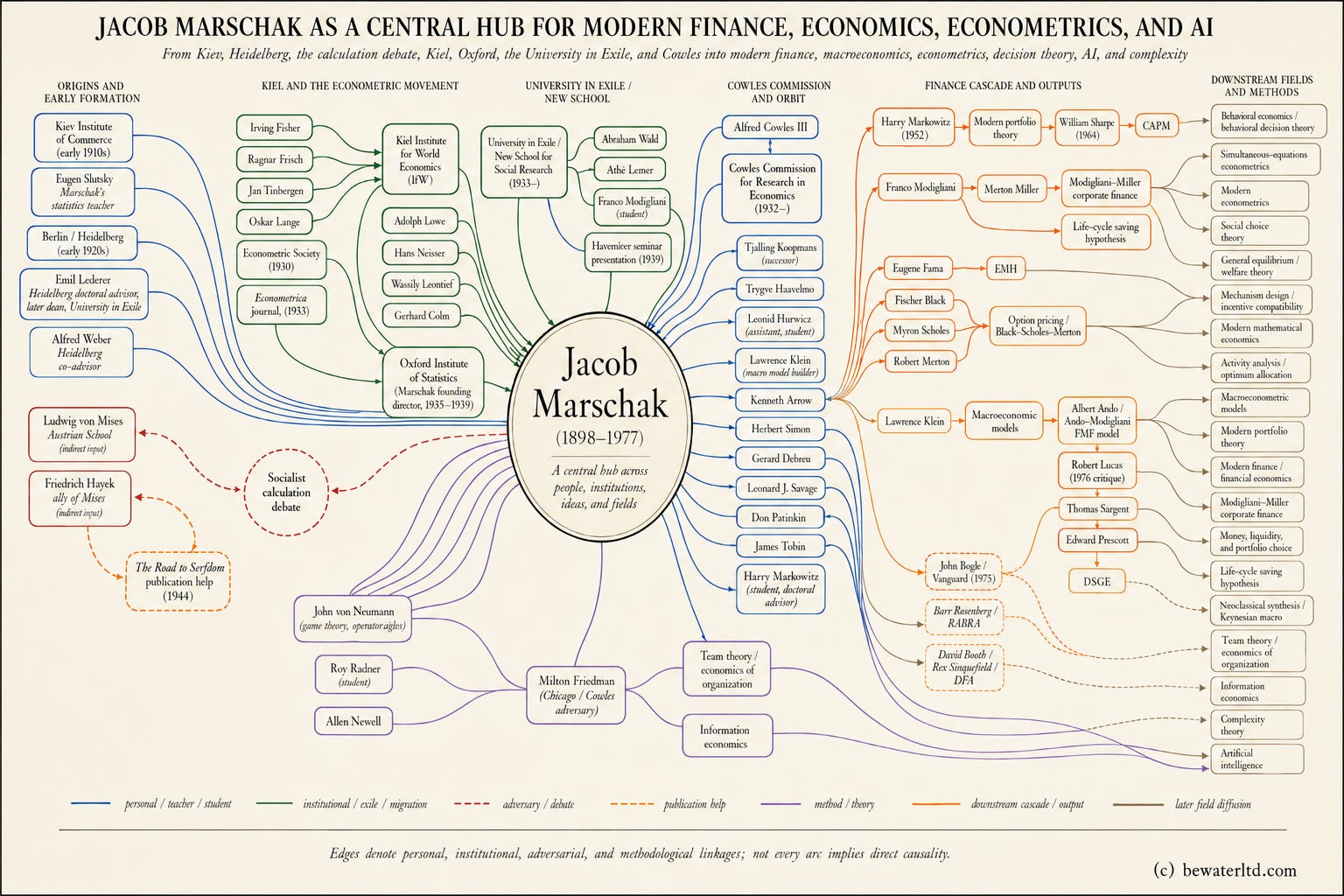
Marschak would find his way, eventually, to Weimar Berlin, then flee the Nazis and land in London; he escaped the impending World War by emigrating once again—this time to America. By the time he reached New York in 1939, Marschak had already involuntarily emigrated three times in two decades—surviving pogroms against Ukrainian Jews, Tsarist prison, the Bolshevik Revolution, two hyperinflations, the Great Depression, Nazism, and the outbreak of a Second World War.
He had escaped all of the old world’s catastrophic attempts to plan society; and yet nonetheless he would spend the next forty years translating the same fatal conceit that had just laid waste to everything around him—the dream of “solving” society—into a new form on American soil.
Up Next:
The Control Surface: Markets As Social Media Feed For Capital

Twitter/X: @bewaterltd | @Mojo Website: bewaterltd.com
Not investment advice. For educational/informational purposes only. See Disclaimer.