


How strangely will the tools of a tyrant pervert the plain meaning of words!
—Samuel Adams
The greatest trick the modern financial system ever pulled was convincing us that we are still playing by the old rules.
In Part I: The Forgotten Man, we showed how the productive middle class has been reduced to a “coppertop battery” whose life force powers the Financial Matrix.
In Part II: The End of Illusion, we explored how raw political force increasingly replaces the illusion of markets. This week’s front-page headlines made the point for us:
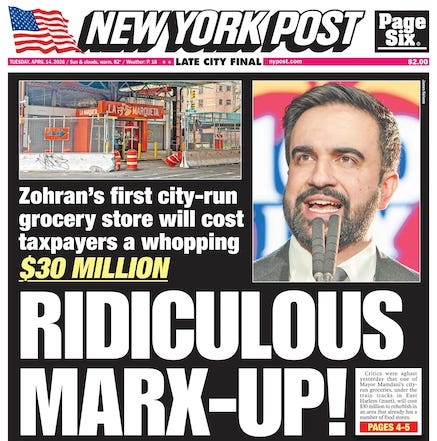


Yet the recent overtly authoritarian turn now dominating both federal and local American headlines is not some sudden aberration. For nearly two decades before the past few months’ headlines—since at least the 2008 Crisis—the Financial Matrix had already been nudging “market” outcomes, its mechanisms invisible because the user interface remained superficially intact. To the casual observer—and even to most professional investors—capitalism appeared unchanged from its pre-2008 form. The operating system beneath, however, had been invisibly rewritten into something else entirely; only the tickers flashing across Bloomberg screens preserved the illusion of continuity.
What changed in 2008 was not so much the rules themselves as the removal of the last guardrail preventing their full application. The Financial Matrix didn’t materialize from the aether; rather, it represents the perfected digital evolution of an analog precursor whose roots stretch back nearly a century—to a revolution most Americans are unaware even occurred.
The 1930s built the underlying hardware: an institutionalized framework of state intervention masquerading as free markets. But it wasn't until the Great Financial Crisis that the system received its digital operating system upgrade—when central bank QE, ZIRP, and the blind algorithmic and passive ETF flows they enabled and amplified were deployed at sufficient scale to make them the “market” itself—effectively masking state intervention as natural market action.
That two-part revolution—the 1930s hardware of state-directed “capitalism”, digitized into the Financial Matrix OS in 2008—preserved market form while shifting their substance to the State. To understand what lies beneath the Financial Matrix’s failing disguise and to make sense of Multiflation—what is happening now, what comes next, and what it all means for your capital—we must return to the source: the Great Depression.
Twitter/X: @bewaterltd | Mojo Website: bewaterltd.com
Not investment advice. For educational/informational purposes only. See Disclaimer.
Note: This is an exercise in Multiflation regime risk assessment, not partisan politics.
The Revolution Was: Phase I
The Great Depression shattered faith in the existing economic order and opened the political field to a wide range of radical proposals for how Western societies should organize themselves. Many competing visions emerged from that crisis. Here, we examine the one that ultimately defined the American system for the remainder of the twentieth century.
(In our series on Value Investing and Ben Graham we will soon turn to a parallel movement. Born of the same crucible but largely driven underground after the 1940s, this technocratic alternative vision has quietly reasserted itself over the past decade—and now, supercharged by the advent of ChatGPT and AI, possesses the tools to build directly on the Financial Matrix’s captured institutions and mechanisms as its own infrastructure.)
But while that alternative technocratic vision was driven underground until recent years, the system that actually conquered twentieth century economics hid in plain sight such that most Americans never noticed anything had changed. Garet Garrett was one of the few who correctly identified the precursor to what would, nearly a century later, reach its perfected form as the Financial Matrix.
In his 1938 essay The Revolution Was, Garrett argued that Americans fundamentally misunderstood the political transformation they were living through under FDR’s New Deal. By maintaining the outward forms of American government, markets, and money—while radically altering their substance—the Roosevelt administration achieved total regime change without firing a shot. Garrett’s book title warned that the coup wouldn’t happen in the future with guns; it had already occurred in the past through words.
Garrett described how the revolutionary New Deal had succeeded through linguistic camouflage:
[It was accomplished] not only within the form but within the word, so that people were all the while fixed in the delusion that they were talking about the same things because they were using the same words. Opposite and violently hostile ideas were represented by the same word signs. This was the American people’s first experience with dialectic according to Marx and Lenin.
The facade of the U.S. Constitution and institutions remained intact, but their underlying meaning and function were now altogether different. Garrett was effectively documenting the resurrection of an ancient political art; Edward Gibbon observed the same strategy nearly two millennia earlier, when Augustus—the first Roman emperor and Julius Caesar’s adopted son—consolidated Roman imperial power:
Augustus was sensible that mankind is governed by names…the senate and people would submit to slavery, provided they were respectfully assured that they still enjoyed their ancient freedom.
The architects of the New Deal, too, understood that Americans would submit to a new order provided they were assured they still enjoyed their ancient liberties. Gibbon’s description of Augustus’ method reads as though it were written about FDR:
The image of a free constitution was preserved with decent reverence: the Roman senate appeared to possess the sovereign authority, and devolved on the emperors all the executive powers of government.
Just as Augustus had preserved the image of a free constitutional republic while concentrating all executive power in himself, FDR absorbed nearly unchecked authority while citizens continued to speak of the “constitution,” “private property,” “free markets,” “prices,” and “capitalism”—unaware that these terms now held altogether different meanings.
Garrett was not alone in his diagnosis of the New Deal. John T. Flynn—a progressive journalist who had written for the New Republic and initially supported FDR before breaking bitterly with the New Deal—saw the same pattern as Garrett and pressed it to its logical conclusion in As We Go Marching. Writing in 1944, Flynn warned that American fascism would not arrive wearing a swastika but rather wrapped in an American flag:
But when fascism comes it will not be in the form of an anti-American movement or pro-Hitler bund, practicing disloyalty. Nor will it come in the form of a crusade against war. It will appear rather in the luminous robes of flaming patriotism; it will take some genuinely indigenous shape and color, and it will spread only because its leaders, who are not yet visible, will know how to locate the great springs of public opinion and desire and the streams of thought that flow from them and will know how to attract to their banners leaders who can command the support of the controlling minorities in American public life. The danger lies not so much in the would-be Fuhrers who may arise, but in the presence in our midst of certainly deeply running currents of hope and appetite and opinion. The war upon fascism must be begun there.
Flynn wasn’t so much forecasting a distant future as he was describing forces already at work under FDR, in language that could have been written about modern-day America:
Fascism will come at the hands of perfectly authentic Americans, as violently against Hitler and Mussolini as the next one, but who are convinced that the present political system has outlived its usefulness and who wish to commit this country to the rule of the bureaucratic state; interfering in the affairs of the states and cities; taking part in the management of industry and finance and agriculture; assuming the role of great national banker and investor, borrowing billions every year and spending them on all sorts of projects through which such a government can paralyze opposition and command public support; marshaling great armies and navies at crushing costs to support the industry of war and preparation for war which will become our greatest industry; and adding to all this the most romantic adventures in global planning, regeneration, and domination all to be done under the authority of a powerfully centralized government in which the executive will hold in effect all the powers with Congress reduced to the role of a debating society. There is your fascist. And the sooner America realizes this dreadful fact the sooner it will arm itself to make an end of American fascism masquerading under the guise of the champion of democracy.
Three New Deals: Precursor To The Matrix
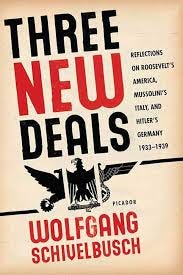
Garrett autopsied this revolutionary transformation in FDR’s America, but the New Deal wasn’t a peculiar accident of American politics—it was merely one manifestation of a homologous global ideological response to the Depression. The Forgotten Man was a global phenomenon; the productive middle class everywhere had been crushed by the Depression—whether in the form of the American yeoman, the German Mittelstand (small business owners) and Frontkämpfer (front-line veterans), or the Italian Ceto Medio (middle class) and Reduci (returned soldiers).
In his desperation, the Forgotten Man on both sides of the Atlantic turned to leaders who promised that State power could restore order. Wolfgang Schivelbusch’s Three New Deals argues that FDR’s America, Mussolini’s Italy, and Hitler’s Germany all converged on remarkably similar economic solutions to the Depression. Each regime chose a ‘revolution within the form’: preserving the comforting symbols and vocabulary of private property and free market institutions while decisively breaking with laissez-faire liberalism.
(Note: To preempt any potential misreading or confusion, this comparison isolates the shared mechanics of state-directed economic policy, not the morality of the three governments. The focus here is strictly economic.)
Rather than abolishing capitalism outright—as did the Bolsheviks in Russia—all three retained its shell, filling it with the machinery of state coordination and planning. Mussolini gave this chimera a name: 'the Third Way’—neither Soviet collectivization nor laissez-faire capitalism, but corporatism, the formal merger of nominally private enterprise with the State.
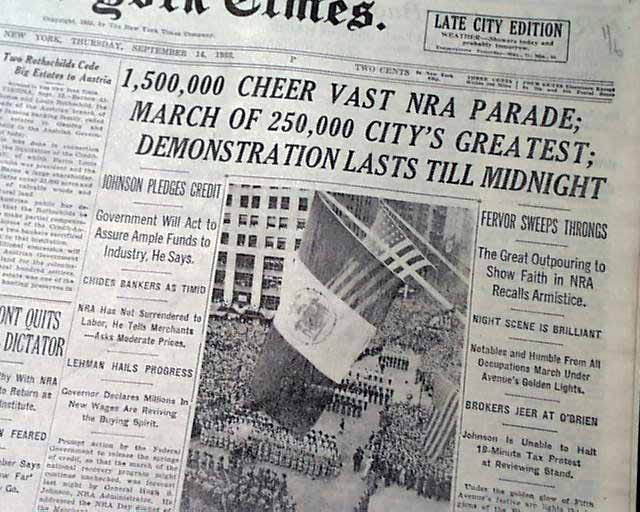
Even contemporaneous critics recognized that beneath the different symbology, similar economic policies were taking hold in all three countries. In Hell Bent for Election, one American critic observed that FDR’s NRA had cartelized industries, fixed prices and wages, and suppressed competition under state direction—its Blue Eagle insignia marking compliant businesses—and drew the uncomfortable conclusion that:
If we had had a Nazi or Fascist party in 1932, perhaps it might have written a platform that would conform to what Mr. Roosevelt tried to foist upon the country under the wings of the Blue Eagle.
As Schivelbusch documented, the official newspaper of the Nazi Party (NSDAP), too, explicitly recognized its kinship to FDR’s policies:
Just as National Socialism superseded the decadent “bureaucratic age” of the Weimar Republic, the Völkischer Beobachter [the official newspaper of the Nazi party] opined, so the New Deal had replaced “the uninhibited frenzy of market speculation” of the American 1920s. The paper stressed “Roosevelt’s adoption of National Socialist strains of thought in his economic and social policies,” praising the president’s style of leadership as being comparable to Hitler’s own dictatorial Führerprinzip. “If not always in the same words,” the paper wrote, “[Roosevelt], too, demands that collective good be put before individual self-interest. Many passages in his book Looking Forward could have been written by a National Socialist. In any case, one can assume that he feels considerable affinity with the National Socialist philosophy.”
The newspaper admitted that Roosevelt maintained what it called “the fictional appearance of democracy,” but it also proclaimed that in the United States “the development toward an authoritarian state is under way.” The author added, “The president’s fundamental political course still contains democratic tendencies but is thoroughly inflected by a strong national socialism.”
Nor were the aesthetic similarities between the regimes lost on Europeans and Americans:
Hitler’s Vampire Economy
Of these three regimes, Hitler’s Germany pushed the revolution-within-the-form furthest, perhaps because the blow to the Forgotten Man was particularly fatal in the case of Germany—where it arrived as the coup de grâce to a society already hollowed out by a devastating military defeat, the shame of Versailles, and the ravages of hyperinflation and cultural revolution.
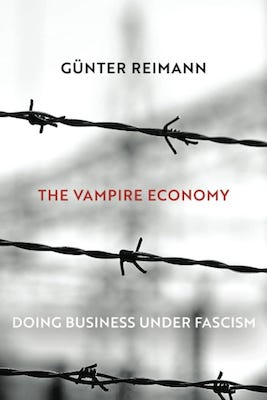
Gunter Reimann’s The Vampire Economy documented in great detail the German system. While the Soviet model of communism—the one that Mamdani’s NYC now takes inspiration from—abolished private ownership entirely, Reimann showed how the National Socialist regime, like that of FDR, meticulously maintained the facade of capitalism.
The German Vampiric system was called Zwangswirtschaft, literally, “compulsory economy”. Nominal private ownership existed alongside the appearance of normal prices, wages, and markets—while the State entirely eviscerated its substance. Entrepreneurs were effectively sidelined, replaced by government-appointed ‘shop managers’ who followed State directives for production and distribution rather than consumer-driven market signals.
Do not be deceived by partisan framing of “right-wing” Nazis versus “left-wing” Communists: the Nazi approach was simply an alternate form of central planning, as Mises explained in Omnipotent Government:
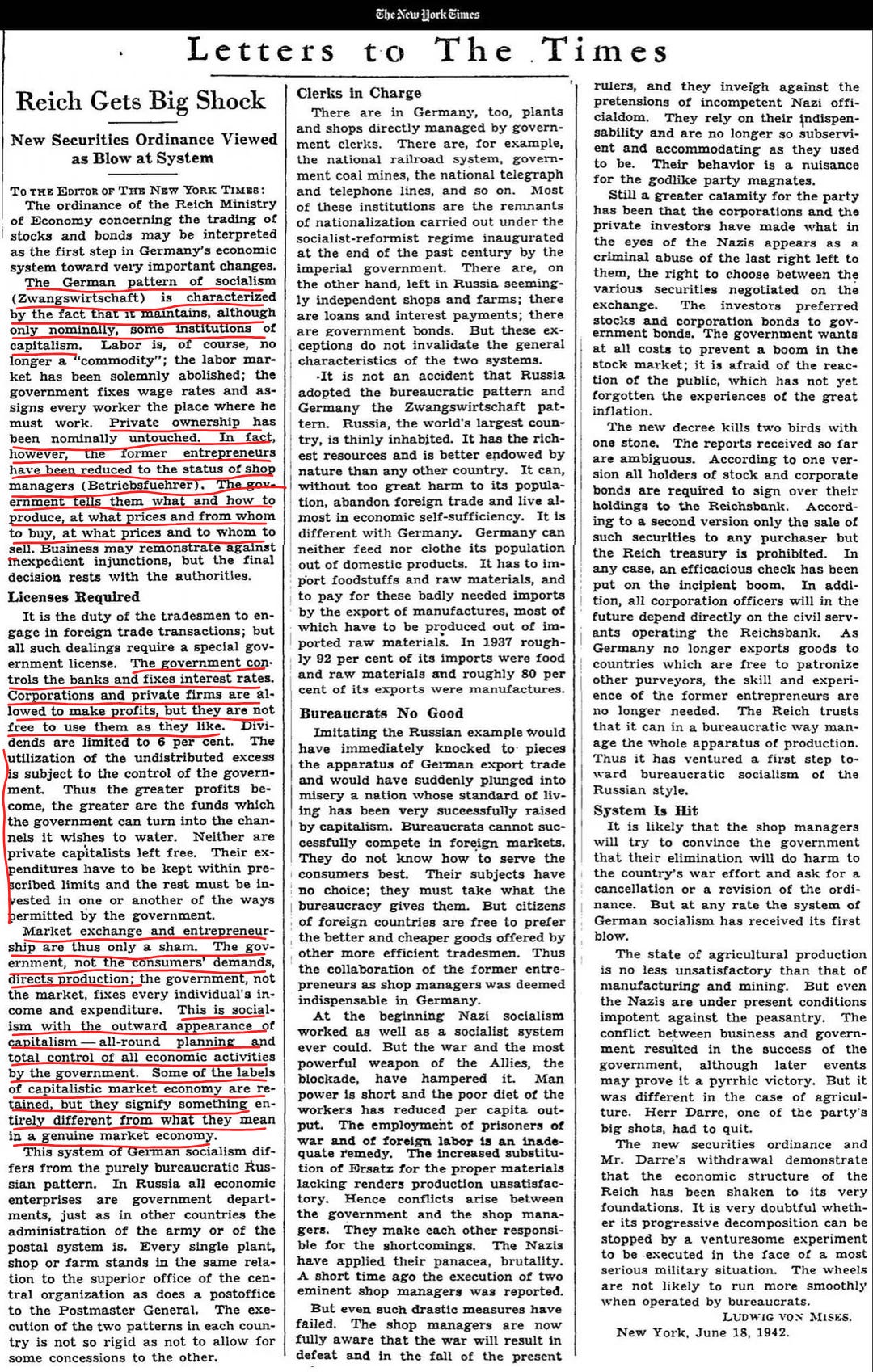
The German and the Russian systems of socialism have in common the fact that the government has full control of the means of production. It decides what shall be produced and how….But there is a difference between the two systems. The Russian pattern of socialism is purely bureaucratic. All economic enterprises are departments of the government, like the administration of the army or the postal system…
The German pattern [of socialism] differs from the Russian one in that it (seemingly and nominally) maintains private ownership of the means of production..There are, however, no longer entrepreneurs but only shop managers (Betriebsführer)…The government tells the shopmanagers what [to do]...Market exchange is only a sham. All the prices, wages, and interest rates are…in appearance only...This is socialism in the outward guise of capitalism. Some labels of capitalistic market economy are retained but they mean something entirely different from what they mean in a genuine market economy.
Mises showed that property rights are not legal title—mere pieces of paper— but rather the power to exercise actual control over resources. Strip that power while preserving the paperwork, and prices lose their anchor: they become proto-HyperPrices, superficially market-determined figures that have been severed from genuine economic meaning and reduced to State ventriloquism.
In June 1942, Mises pressed the same case directly to the American public in a letter to the New York Times—arguing in real time, while the war still raged, that the Reich's economic system was not the opposite of socialism but its twin, dressed in capitalist clothing.
Whenever private capital attempted to exercise economic control independently of State imperatives, the Vampire Economy bared its fangs—for example when Hitler’s economic enforcer, Hermann Göring, clashed with industrialists over resource control:
Göring insisted that the Ruhr, like the rest of German business, must subordinate its private interests to the national need, pointing to the fact that Germany was heavily dependent on foreign sources of iron ore…and so more vulnerable than in 1914 [WWI], a comparison to which Hitler constantly returned…Göring demanded that the Ruhr industrialists should undertake the development of the low-grade ores in central and southern Germany. When they refused, he declared that “the State must take over when private industry has proved itself no longer able to carry on…”When the iron and steel industrialists produced a paper rejecting Göring’s autarkic policy, he threatened them with arrest as saboteurs and compelled the private firms to invest some of their own funds in the state-owned competitor with which he now confronted them. Krupp was offered a large arms contract at the same time in order to split any attempt at a united front in opposition.
2008: The Operating System Rewrite

The Nazi Vampire Economy was not an aberration that died with Hitler in 1945. What Hitler had taken to its logical extreme, the New Deal’s “revolution within the form” implemented in softer form—and the underlying blueprint, stripped of its jackboots, quietly became the architecture of postwar “capitalism”.
For seventy-five years, the New Deal’s institutions underpinned the American economy—and, as the US supplanted Britain as the epicenter of global finance, the world's as well; we’ve traced some of this history in the Metamorphosis of Money, the Keynesian Kaleidoscope, the Alchemy of Risk, and elsewhere in the Sorcerer’s Apprentice.
This apparatus of hidden state control expanded almost imperceptibly over the ensuing decades: first through the New Deal and Bretton Woods system, and then through the 1971 severance of the dollar from gold, which removed the last constraints on a fully hyperreal economy.
Then, in 2008, the financial system ruptured. What we think of as the “subprime crisis” was not a “black swan” or a one-off “market failure” caused by a few years of subprime and CDO excesses, but rather the inevitable culmination of decades spent perfecting the Vampire Economy through the dark art of risk transmutation.
The Great Financial Crisis and governmental responses—Money Printer Go BRRR—birthed a second revolution within the form, precipitating a phase transition in which the financial markets were predominantly nationalized by stealth. If the New Deal redefined the vocabulary and institutions of capitalism, 2008 digitized the Vampire Economy, birthing the Financial Matrix.
The Vampire Revealed
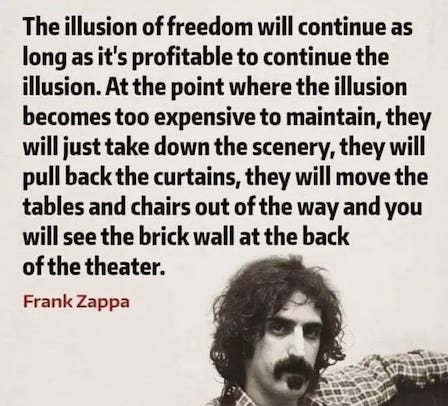
The Financial Matrix’s genius was its invisible system of wealth extraction from the Forgotten Man—who watched helplessly as his purchasing power was eroded, his savings devoured by inflation, his prudence punished, and his virtue mocked by a system that rewarded speculation and fraud.
The mechanisms corrupting capitalism were so arcane that the immiserated middle class could never quite identify its assailant—and so the illusion held. Meanwhile, wealth exploded for those positioned inside the Matrix—asset holders armed with access to cheap credit, the ability to front-run or shape government-directed capital flows, and the Plunge Protection Team’s put.
Central banks stopped intervening in markets at the margins and became the market—the State the ultimate “market” participant, the remaining substance of capitalism replaced with a videogame simulation. The user interface—tickers, stock prices, property titles—remained intact, but the underlying operating system was replaced with State-conjured “liquidity”—the raw fuel for blind algorithmic flows that transmitted and amplified both across every market.
The 2008 rewrite of the global economic operating system perfected the Vampire Economy’s operating model and extended the blueprint beyond the financial markets. Governments need not nationalize what they can control by other means. After 2008, that principle metastasized invisibly across three interlocking fronts: financial, industrial, and informational.
Front I: Financial
The Vampire Economy commandeered the financial plumbing through which all capital flows—and it extended well beyond the QE, passive flows, and algorithmic amplification already examined.
At the commercial banking level, for example, the State need not explicitly nationalize the banks; it need only make bankers understand who they ultimately work for. Marc Andreessen detailed the insidious nature of modern “debanking” and Operation Chokepoints 1.0 and 2.0: financial institutions serve as instruments of government and ideological control while maintaining the facade of private enterprise. While one might debate the accuracy of Andreessen’s claims, his core observation is salient and mirrors a well-documented historical pattern; indeed, Gunter Reimann explored how banking institutions were transformed from pillars of private enterprise into whips of the authoritarian state in Vampire Economy:
Within Germany itself, the banker’s activities are likewise circumscribed. He plays a dual role, a fact which creates many unpleasant and even risky situations for him. He is the head of a “private enterprise,” yet he must always act like a representative of the State. A private investor would be naive if he continued to rely on the advice of “his banker” whom he has known for many years and who formerly advised him how to invest his money. The advice he would get now would consist only of the instructions the banker gets from the Government…it is not illegal to refuse, but inadvisable. If he withdraws large funds for private investments or otherwise remains stubborn, the banker will have to send a report to Government authorities informing them about the case. They will then check on how the money is used. The local Party leader will keep in touch with the bank manager, too, and learn of withdrawals or of the existence of liquid assets and make use of this knowledge... These big banks are today… under private ownership. This fact easily misleads the foreign observer. For under fascism “private banks” are as much under State control and are as co-ordinated as ordinary State banks. The transformation of the big banks from protectors and pillars of private enterprise to the whip of the authoritarian State to be used in controlling private enterprise…
This pattern of control is now hardcoded into the Financial Matrix; it was again clearly illustrated by the 2022 Canadian trucker protests—during which time the government invoked emergency powers to freeze the bank accounts of protestors and their donors, transforming private banks into direct enforcement arms of the state overnight.
Front II: Industrial
While American regulators—to date, anyway—rarely threaten industrialists with outright arrest as did Herr Göring and the Nazis, State-directed capital allocation continued from the New Deal to the present in various guises.
Regardless of one’s view on the necessity of such policies, when government-mandated ESG or “national security” industrial policies regarding climate change, Anthropic AI, rare earths, and semiconductors force capital allocation based on political rather than economic dictates, the State effectively transfers a portion of de facto control from shareholders to itself, leaving shareholders with nothing but empty words and a paper illusion of ownership.
The State need not nationalize a factory outright: it need only control the conditions under which private capital may operate: which industries receive credit, which are starved, which “private” firms receive government contracts as a reward for compliance—and which are threatened with legal and regulatory strangulation for defiance.
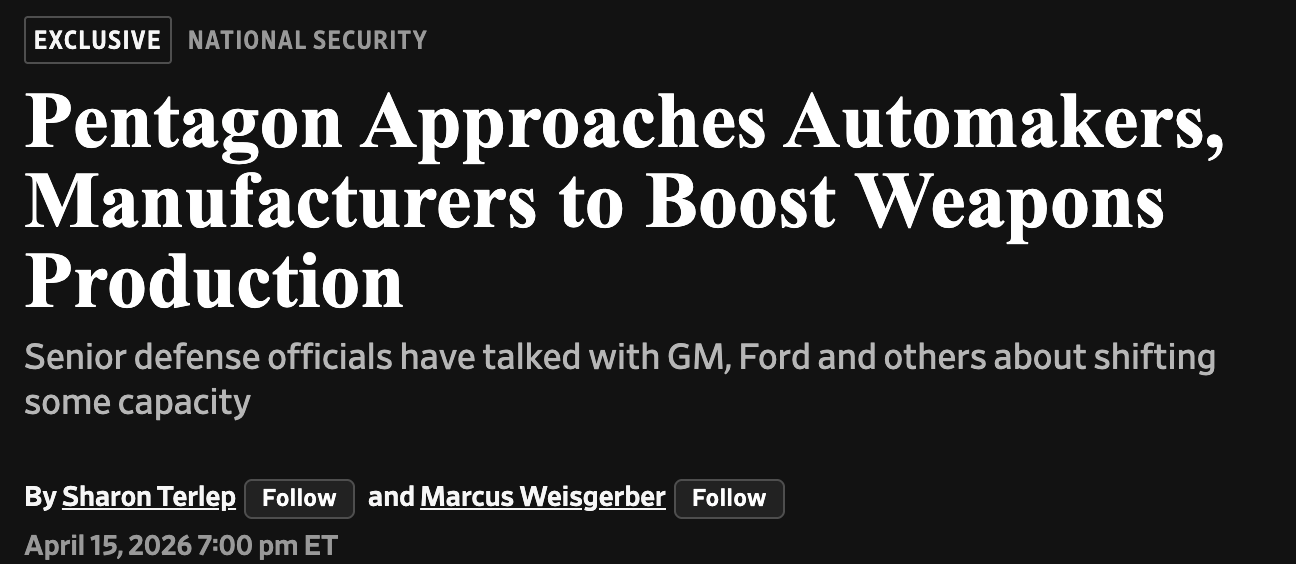
Just as Göring compelled German industrialists to subordinate private capital to state imperatives, the modern American regime increasingly dictates the deployment of private wealth. This week the Pentagon approached General Motors and Ford about converting production capacity to arms and military supplies—echoing Göring's demands on the Ruhr industrialists (and America’s own wartime conversion of Ford’s plants to bomber production):
Front III: Informational
Just as the Vampire Economy required command over capital and industry, it demanded an equally tight grip on discourse. Mirroring the strategies of the first two fronts, the State avoided the messy optics and legality of nationalizing the press or the internet outright. Instead, it outsourced enforcement—ensuring platforms, broadcasters, and payment processors understood the economic and legal consequences of permitting certain viewpoints.
Deplatforming, demonetization, algorithmic suppression, and advertiser boycotts achieved what outright censorship would have made obvious: the systematic removal of dissent and crimethink. The infrastructure of speech—search, social, payments, cloud hosting—remained in ostensibly private hands but was de facto State-directed.
The Twitter Files, for example—documented by Matt Taibbi and colleagues, and submitted to the Supreme Court in Murthy v. Missouri—exposed the operational details: government agencies routing content suppression through nominally private platforms. The vocabulary of the first amendment and free press was preserved; their substance was not.
The 2020 Glitch: Mr. Market’s Schizophrenic Break
The illusion of free markets held, mostly, for twelve years after the Great Financial Crisis. Then the COVID era forced the system into overdrive, and the sheer scale of the intervention short-circuited the Financial Matrix.
As governments printed trillions and locked down the global economy, the schizophrenic disconnect between Wall Street’s manufactured prosperity and Main Street’s economic ruin became too vast to conceal. The Forgotten Man finally saw glimpses of the underlying code.
Now, as the “coppertop batteries” run dry, the Matrix is glitching, and the “desert of the real” is bleeding through the screen. The comfortable fiction of free-market capitalism died, and the Vampire Economy is laid bare.
The financial illusion is now buckling under the weight of compounding, real-world Multiflationary shocks: a replay of the Smoot-Hawley tariff wars as “economic security” and autarky replace free trade; kinetic conflict spreading across Eastern Europe, the Middle East, Venezuela, and beyond; accelerating stagflation amidst crippling spikes in energy and commodities; the weaponization of currencies, shipping lanes, and supply chains; and widespread civil unrest against open borders, the soaring cost of living, and the managed decline of the Forgotten Man.

These are not isolated events, but rather symptoms of Multiflation: the fracturing of the “great moderation” and the post-WWII “rules-based order.”
Conclusion: The Desert Of The Real
The last vestige of the substance, or even the forms, of the constitution was obliterated from the practice and memory of the Romans; and they were devoid of knowledge, or virtue, again to build the fabric of a commonwealth.
—Edward Gibbon
What we are witnessing is not the birth of something new, but rather the perfection and revelation of a century-old process—and the death of the illusion that disguised it.
We have entered an era in which capital is no longer yours to deploy as you see fit; it has been redefined as a resource held in provisional custody, subject to recall whenever the sovereign sees fit. What was once private property is now a mere license—revocable, conditional, contingent on compliance.
This is the inheritance of the revolution-within-the-form. FDR’s New Deal put the State inside the market; 2008 digitized the Vampire Economy and extended it across every front of modern life. The substance migrated to the sovereign while the citizenry, comforted by familiar words and flickering numbers, scarcely noticed.
The Forgotten Man is perhaps beginning to notice now. This transition from private property to state-managed license is increasingly visible at every level of Western society: from Mamdani’s NYC; to the state level—California sweeping dormant digital assets into state coffers, Washington and a growing list of states engineering wealth and exit taxes; to the Federal policies of the Trump administration.
Nor is this a uniquely American phenomenon; it is a global movement toward a compulsory economy across the Western world. At Davos, “stakeholder capitalism,” “15-minute cities,” CBDCs, and more are championed as inevitabilities.
In Germany, proposed legislation would block individuals from purchasing homes based on "anti-constitutional" views—granting local authorities first refusal on sales and allowing intelligence agencies to vet buyers without a criminal conviction. From Ireland’s systematic use of forced purchase orders and punitive taxes to compel private property into state-mandated utility, to Canada’s debanking and agreements with first nations, private property is being compelled into the service of the state.
Up Next: Part IV
In Part IV, we examine what happens when the systemic failure of the Financial Matrix escapes the confines of the financial markets. History shows that when the financial illusion fails, the Forgotten Man’s rage flows toward whatever symbols of the new order are nearest at hand—the perceived architects and beneficiaries of the system.


Add the accelerant of Artificial Intelligence—which threatens to creatively destroy wide swaths of the economy—and you have the recipe for an explosive cocktail. As the vanguard of the digital economy is now discovering, that “explosive cocktail” is no longer mere metaphor, but rather a literal Molotov lobbed at their front door:


The next day, a second attack occurred at Altman’s house, this time a shooting:

These attacks are not merely isolated symptoms of societal decay or neo-luddism; they are the kinetic real-world eruptions triggered as the Financial Matrix fails and the tectonic forces of Multiflation, unleashed by its collapse, crash into one another. As the Forgotten Man’s purchasing power evaporates, the technocratic “Alternative Vision” poses a threat—whether real or perceived—of finalizing his economic obsolescence.
The Multiflation Method
The question is no longer whether Multiflation is transforming the global economic landscape, but how to successfully navigate its forces. Multiflation demands a reassessment of risks that have not been taken seriously for nearly two decades: counterparty risk, geographic vulnerability, political risk, and the accelerating possibility that the rules governing ownership and property rights will be rewritten mid-game. The Multiflation Method is our evolving investment framework, and we’ll address each of these risks in essays to come.
Be Water.